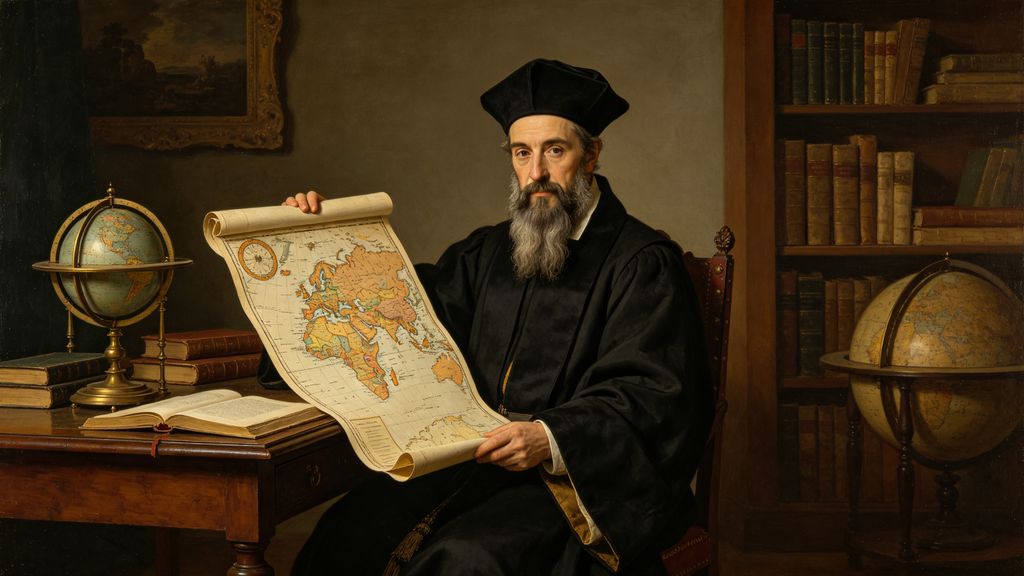
Matteo Ricci was born in Italy in 1552. In 1582 the Jesuit priest reached Macao, then spent 27 years in China — never returning home.
Ricci was brilliant. He learned Chinese and Chinese customs, dressed as a scholar, took a Chinese name, and wrote books explaining Western ideas in Confucian language. He brought a world map (the Kunyu Wanguo Quantu) showing for the first time that Earth is round with five continents; he brought clocks, prisms and telescopes that amazed Ming scholars.
His most famous friend was the scholar Xu Guangqi. Together they translated Euclid's Elements into Chinese — coining words still used today: diǎn (point), xiàn (line), miàn (plane), sānjiǎoxíng (triangle), píngxíng (parallel). He also drew maps and translated astronomy with Li Zhizao, systematically introducing Western science to China.
Ricci died in Beijing in 1610; the Wanli Emperor allowed him to be buried there. He was a bridge between two cultures — carrying Western science into China and Chinese thought back to Europe. His tomb outside Fuchengmen is still visited by scholars today.
Matteo Ricci (1552-1610), an Italian Jesuit, arrived in Macau in 1582 and entered Zhaoqing, Guangdong in 1583, later living in Shaozhou, Nanchang, Nanjing and Beijing for 28 years - one of the most important figures in Sino-Western cultural exchange.
His "when in China" strategy: he first wore Buddhist robes, but discovering that Chinese society respected Confucian scholars, he switched to scholar dress, grew hair and beard, and learned Chinese speech and books. Presenting himself as a "Western Confucian" opened doors in elite society.
Bringing Western science: he introduced not only religion but mathematics, astronomy and geography. With Xu Guangqi he translated Euclid Elements; he drew the Kunyu Wanguo Quantu (the first world map in China); he presented globes, clocks and telescopes to the court, giving Chinese their first direct view of the world.
His writings: True Meaning of the Lord of Heaven (the first systematic theology in Chinese), On Friendship, and Ten Discourses. Writing fluently in Chinese, he impressed Chinese scholars.
The "Ricci rule": he allowed converts to keep ancestral and Confucian rituals, judging them compatible with Catholic doctrine - a flexible policy that became a model of cultural accommodation.
Visits: his tomb lies in Xicheng District, Beijing (Zhalan cemetery), beside the tombs of Ferdinand Verbiest and Johann Adam Schall; Zhaoqing has a Ricci memorial; Macerata, Italy is his birthplace with a museum. He is the best entry point for understanding how Westerners entered China.
Ricci lesson for today: he lived 28 years in a wholly foreign culture not by force but by understanding others and adapting. Many foreigners working in China today find resonance - learn the language, read the human relationships, and doors open. His tombstone inscription remains legible: "Tomb of the Jesuit Li."

