In 221 BC, King Zheng of Qin conquered the remaining six states and founded China's first unified empire, calling himself Shi Huangdi - "the First Emperor".
Unification meant more than conquest: he standardised the script (small seal), weights and measures, currency (the round coin with a square hole) and the axle width of carts, so the whole realm shared one script and one road gauge.
These measures laid the cultural bedrock of Chinese unity: for over two millennia, through every dynasty, China has remained one country with one script and one set of standards.
The First Emperor also left harsh legacies: burning books, burying scholars, the Great Wall, the Epang Palace and his mausoleum at Mount Li - crushing corvee labour, and the Qin dynasty fell after just 15 years.
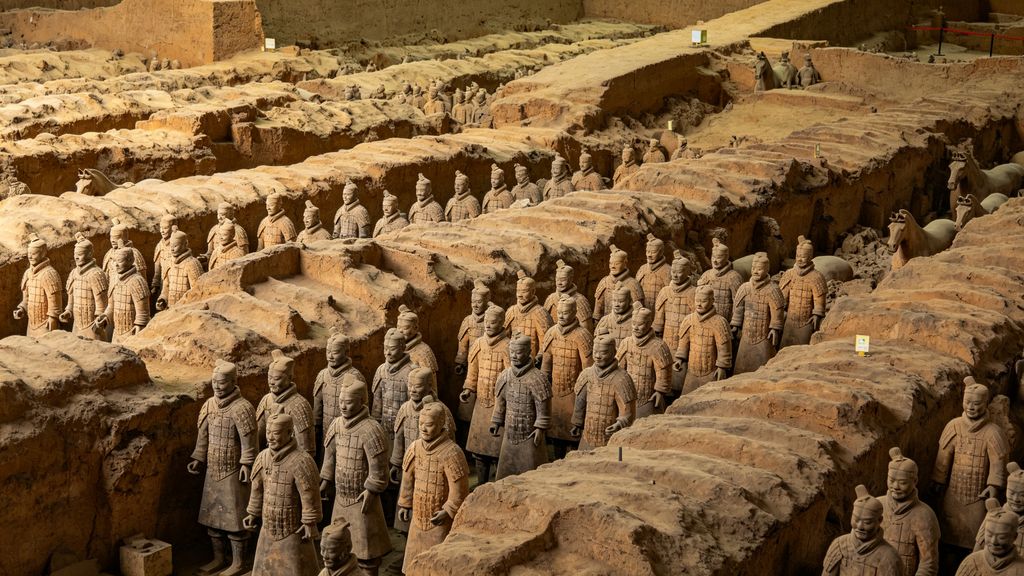
Today the Terracotta Army, the burial pits of his mausoleum, is among the world's most famous archaeological finds: over 8,000 life-size clay soldiers, silently telling of his majesty in life and his legend after death.
In 221 BC a great event occurred in Chinese history: Qin Shi Huang unified the six states and founded the first centralised dynasty - the Qin.
Qin Shi Huang, originally Ying Zheng, ascended at thirteen and took power at twenty-two. In ten years he destroyed Han, Zhao, Wei, Chu, Yan and Qi, ending over five centuries of wars.
After unification he made a series of "firsts": first to be called "emperor", first to unify script, weights and measures, first to build national highways.
"Same script" was the greatest: states wrote characters differently; he ordered standard "small seal script" nationwide. Henceforth Chinese read and wrote in one shared language.
"Same track": he unified wheel gauge so carts could travel nationwide - like standardising highway gauge today.
He unified currency: the round coin with square hole "banliang" became universal; unified measures so trade had common standards.
These reforms turned formerly separate states into one country. The concept of "China" begins with the Qin.
He also built the Great Wall against the Xiongnu and highways linking the capital to the whole country.
But he had a cruel side: burning books and burying scholars drew later criticism; building the Epang Palace and his tomb burdened the people unbearably.
After his death the Qin fell quickly, lasting only fifteen years. Yet its institutions endured: the Han "inherited Qin system", and later dynasties kept the commandery system.
"Qin emperor and Han emperor Wu" are paired as the mightiest imperial ages in Chinese minds. His merits and faults have been debated for two millennia.
Today Great Wall, Terracotta Army, commandery system and unified script all trace to him. The state framework he built shaped China for over two thousand years.
One apt verdict: "his merit is unmatched; his fault likewise unmatched." Both his achievements and errors were unprecedented.

