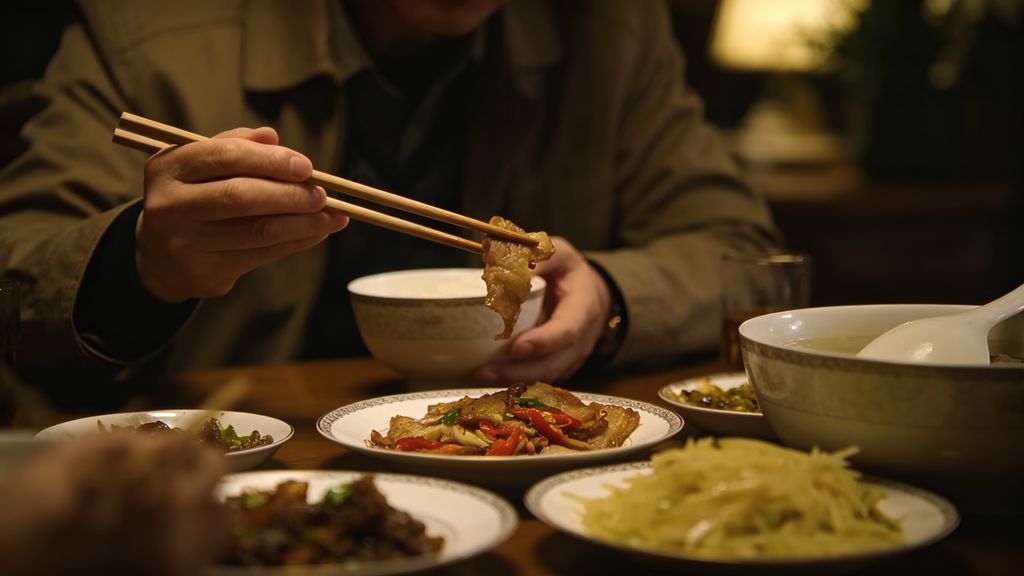
Chopsticks are the main eating utensil for Chinese people, with over 3,000 years of history. The earliest chopsticks were called "zhu"; later, due to naming taboos, they were renamed "kuai" (fast), and with the bamboo radical added, became "kuaizi" (chopsticks). A Chinese person eats three meals a day, using chopsticks over 2,000 times a year.
Holding chopsticks has its own rules. The correct way: thumb and index finger pinch one chopstick, middle finger supports from below, ring finger and pinky hold up the other. One moves, one stays still—this is how you pick up food. Where you hold the chopsticks also has meaning—hold them too high and you'll marry/marry far; hold them too low and you lack ambition.
Using chopsticks has many rules. Don't stick chopsticks upright in rice—it looks like incense offered to the dead. Don't tap bowls with chopsticks—that's what beggars do. Don't point at people with them—rude. Don't dig through the dish looking for something. Don't cross them after eating—it's unlucky.
Chopsticks are more than utensils—they're a cultural symbol. When treating guests, Chinese people always serve food to guests with chopsticks as a sign of warmth. At weddings, newlyweds get a pair of chopsticks, meaning "may you soon have a son" (chopsticks sound like "quick son"). Giving chopsticks as a gift means "a lifetime of happiness."
Today, chopsticks have spread around the world. Whether in Chinese restaurants or foreigners' homes, more and more people are learning to use chopsticks. Two small sticks contain Chinese philosophy—yin-yang balance, one moving and one still, perfect coordination. Next time you eat, take a moment to feel the chopsticks in your hand.
Chopsticks are the two small sticks Chinese use for eating. They look simple, yet are a "magic tool" used for over three thousand years, hiding much knowledge.
Their history is long; prototypes appeared as early as the Shang dynasty. One end round, one end square - symbolising "round heaven, square earth"; the pair, yin and yang, represents balance.
Rules abound. Never stick chopsticks upright in a bowl of rice - that resembles incense for the dead, very unlucky; never tap the bowl with chopsticks - a beggar habit; never point chopsticks at others - impolite.
Etiquette: elders begin first; when picking food, take from your own side; offer chopsticks to guests as welcome.
Chopsticks express feeling: picking food for a guest is hospitality; for a lover, affection; for an elder, filial respect. They lift not only food but the bond between people.
Chinese food suits them: hotpot mutton must be quick; noodles lifted steady; xiaolongbao grasped precisely. Handling chopsticks is a skill.
Now more and more people worldwide use chopsticks for Chinese food. Some foreigners cannot pick up a peanut at first and sweat with effort - practice a few times; Chinese children learned the same way.
When in China, try a Chinese meal with chopsticks. Remember: "kuàizi" chopsticks. Master them, and you master the joy of "eating at the same table" with Chinese people.
One pair of chopsticks lifts food and connects hearts - that is the Chinese philosophy of chopsticks.

