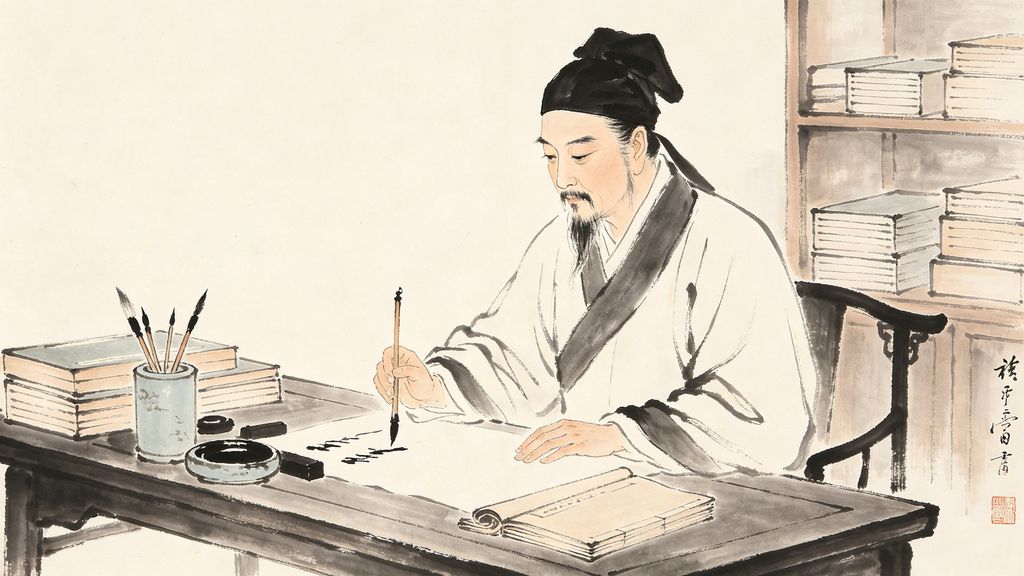
Cao Xueqin (c. 1715-1763), name Zhan, courtesy name Mengruan, art name Xueqin. He was a novelist of the Qing dynasty, author of "Dream of the Red Chamber," one of China's Four Great Classical Novels. He spent ten years writing this book—"edited for ten years, revised five times"—but died before finishing it. The last 40 chapters are generally believed to be continued by Gao E.
Cao Xueqin was born into the Plain White Banner of the Imperial Household Department. His great-grandmother was Emperor Kangxi's wet nurse, his grandfather Cao Yin was Kangxi's reading companion, and later served as Jiangning Weaving. Kangxi visited the south six times, staying at the Cao family four times. At that time, the Cao family was the most prominent family in Jiangnan, with extravagant imperial receptions.
But good times didn't last. After Emperor Yongzheng ascended the throne, he started auditing finances. The Cao family was raided for deficits. Overnight, from a "family of bells and tripods" to "overgrown paths." Cao Xueqin went from a rich young master to a poor commoner, moving to the western suburbs of Beijing, living in a thatched cottage—"the whole family eats porridge, often owing for wine."
In these impoverished days, Cao Xueqin started writing "Dream of the Red Chamber." He poured his whole life's experience, his family's rise and fall, and his understanding of life into the book. The novel centers on the tragic love of Jia Baoyu and Lin Daiyu, describing the rise and fall of four great families, and creating hundreds of vivid characters.
"Dream of the Red Chamber" is the peak of classical Chinese fiction, called "the encyclopedia of Chinese feudal society." Since the Qing dynasty, there has been a specialized field of study called "Redology"—no other novel has ever received such treatment. If Cao Xueqin knew, he would be comforted—the book he wrote in poverty for ten years became China's eternal treasure.
Cao Xueqin (c. 1715-1763) is the great Qing novelist, author of Dream of the Red Chamber (Hong Lou Meng) - the pinnacle of classical Chinese fiction, called "an encyclopedia of Chinese feudal society" - yet he himself died poor and unknown.
Family and life: he was born into the Cao family of Jiangning Weaving, whose head Cao Yin enjoyed Emperor Kangxi deep trust; three generations ran the Jiangning imperial textile works, one of the most prominent families in Jiangnan. But under Yongzheng the family was confiscated; Cao Xueqin fell from silks and jade to a scholar eating gruel, and in his later years wrote in the hills west of Beijing.
The creation: "read and revised for ten years, deleted and added five times" - he spent a decade writing and revising, but completed only the first 80 chapters before illness took him; Gao E finished the remaining 40. An unfinished book became the greatest regret and deepest mystery of Chinese literary history.
What it tells: against the rise and fall of the Jia, Shi, Wang and Xue clans, it traces the tragic love of Jia Baoyu and Lin Daiyu through the whole decline of the Jia mansion. Over 900 characters, more than 200 poems - truly an encyclopedia.
Why it is so great: it is not just a love story but a portrait of feudal society - officialdom, human relations, economy, culture, women fates. Lu Xun said it broke the "happy reunion" cliché by daring to write tragedy; Lin Daiyu, Jia Baoyu and Wang Xifeng are all flesh-and-blood figures.
Red Studies and visits: studying the book is a discipline called "Redology". Beijing Grand View Garden (built for the TV drama), Zhengding Rongguo Mansion, Cao Xueqin Memorial in Liaoning and his former residence in Beijing Botanical Garden (said to be where he wrote) are all must-visits for fans.

