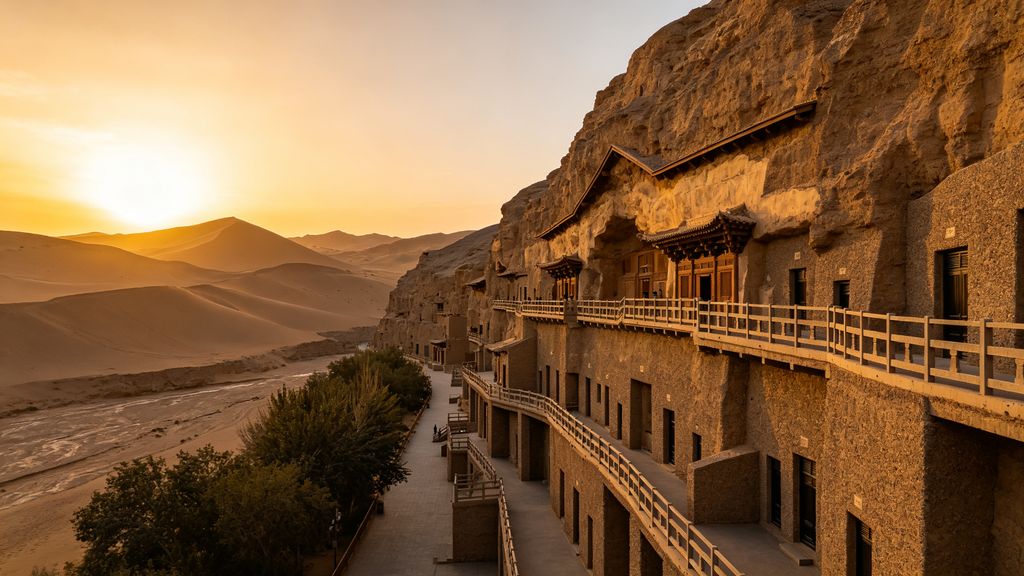
On the eastern cliffs of Mingsha Mountain, 25 km southeast of Dunhuang, Gansu, are 735 caves packed into the rock face. These are the Mogao Caves, also called the "Thousand Buddha Caves." They stretch 1,680 meters north-south across 5 levels, with 45,000 square meters of murals and over 2,400 painted sculptures. If you lined up all the murals in a 1-meter-high corridor, it would stretch 45 kilometers.
Construction of the Mogao Caves began in 366 AD and continued through the Yuan dynasty—over a thousand years of work. Legend says a monk named Le Zun saw golden light shining from Sanwei Mountain, like a thousand Buddhas appearing, so he carved the first cave. Over the next millennium, Silk Road merchants and believers funded more caves, creating this treasure trove of art.
The murals are not just Buddhist stories—they show daily life from 1,000 years ago: farming, hunting, weddings, banquets, and dancing. You can see how people dressed, what they ate, and how they danced. These murals are a living history of ancient Chinese life, painted on the walls.
In 1900, a Daoist monk discovered the "Library Cave" while cleaning—50,000 documents and artifacts from the 4th to 11th centuries. Many were taken by Western explorers and dispersed to museums around the world. This is one of the greatest losses in Chinese archaeology and the saddest chapter of Mogao history.
If you travel to Dunhuang, the Mogao Caves are a must-see. Note: no photography inside the caves—preserving the murals is critical. Book tickets in advance during peak season, and you can only visit 8 caves with a guide. If you love history and art, hire a guide—otherwise the murals all look similar to untrained eyes.
Dunhuang Mogao Caves, in Dunhuang city, Gansu province, are the world largest and richest treasure house of Buddhist art - the "art gallery in the desert".
The caves were begun in 366 AD. A monk named Lezun passed Mount Sanwei, saw golden light as if a thousand Buddhas appeared, and carved the first cave into the cliff.
For over a thousand years, from the Sixteen Kingdoms to the Yuan dynasty, each era added caves and statues. Now 735 caves survive, with 45,000 square metres of murals and over 2,000 painted sculptures.
The caves centre on Buddha images: the largest over 30 metres tall, the smallest about a dozen centimetres. Sculptures vary in expression, flowing drapery, lifelike.
The murals cover everything: Buddhist stories, flying apsaras, music and dance scenes, hunting and farming, merchant caravans - a "history in pictures".
The "apsara" (feitian) is the most beautiful image: maidens with ribbons streaming, dancing in the air, scattering flowers or playing music - embodying Chinese imagination of freedom and beauty.
In 1900, Daoist Wang Yuanlu discovered the Library Cave while clearing rubble: over 50,000 documents from the 4th to 11th centuries - "the key to opening the door of medieval history".
Sadly, after discovery, huge quantities were taken by Aurel Stein, Paul Pelliot and others; they now lie in museums worldwide - the deepest wound in Chinese relic history.
To protect the caves, China founded the Dunhuang Research Academy. Generations of scholars rooted in the desert restore murals and copy caves - the "guardians of Dunhuang".
Dunhuang studies became an international field - "Dunhuangology". Ji Xianlin said: Dunhuang is in China; Dunhuangology belongs to the world.
Today digital technology scans murals in high resolution; visitors can view all caves on the Digital Dunhuang website.
In 2023 visitor numbers hit records. To prolong the relics, visits are limited by reservation, with only some caves open daily.
"Lone smoke rises straight over the desert, the setting sun is round over the long river." Dunhuang is an art miracle China gives the world - worth seeing once in person.

