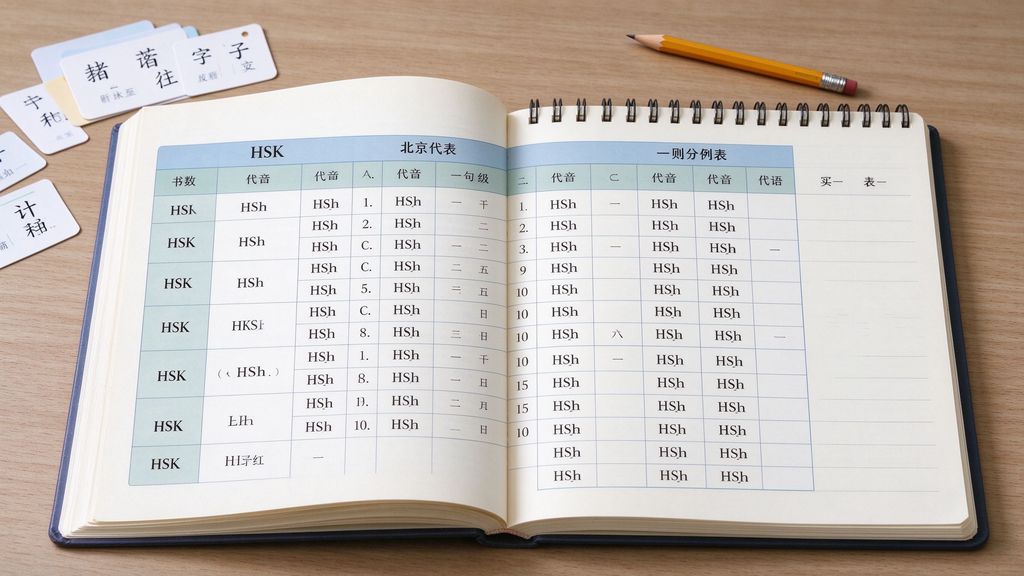
HSK (Hanyu Shuiping Kaoshi) is the official standardized Chinese proficiency test with six levels (HSK 1-6). Levels 1-2 are for absolute beginners with the most basic vocabulary; levels 3-4 are intermediate, covering everyday and study tasks; levels 5-6 are advanced, close to native reading and expression.
Each level covers Listening, Reading, and (from level 3) Writing. Total scores are 300 (200 for levels 1-2), with a typical pass mark of 180 — always confirm with the official announcement for your session.
Choose your level with the official mock tests or vocabulary reference: HSK 1 ≈ 150 words, HSK 2 ≈ 300, HSK 3 ≈ 600, HSK 4 ≈ 1,200, HSK 5 ≈ 2,500, HSK 6 ≈ 5,000. Match the level to your goal — study, work, or interest.
HSK scores are recognised by over 3,000 universities and many employers worldwide. Chinese universities generally require HSK4 for undergraduate admission and HSK5 or 6 for graduate programmes; recruiters also treat it as objective proof of Chinese ability. So decide your goal before registering - what the score is for determines the level and how long to prepare.
Listening is a weak spot for many candidates. HSK audio is slower than classroom speech, but the options are dense and two answers can look similar. Advice: 20 minutes of intensive listening daily - listen once without the transcript, check new words against the text, then shadow-read aloud. A month of this clearly lifts accuracy.
Reading tests vocabulary and fast scanning. From HSK4 up, passages are long; read the question first, then scan back for keywords instead of reading line by line. Practise under time pressure: HSK5 reading is about 40 questions in 45 minutes, roughly a minute each - speed comes from drilling.
Writing starts at HSK3: describing pictures, sentence making and short essays. Markers value complete sentences, accurate grammar and using the given words. Prepare by memorising common patterns (“not only... but also...”, “although... yet...”) and keep essays to 80-150 characters in a clear overall structure.
Timeline: HSK1-2 about 2-3 months, HSK3-4 about 4-6 months, HSK5-6 half a year to a year. Steady 1-2 hours a day beats weekend cramming. Two weeks before the test, do 2-3 full mock papers to rehearse pacing and answer-sheet filling.
Results and certificates: computer and paper tests carry equal weight; scores appear on the official site about two weeks later, and paper certificates reach the centre within 1-2 months. You may apply for score verification within the stated window if you doubt the result.
A common mistake: some jump levels thinking higher is always better, then fail listening or writing. The safe way is to take levels in order, or do a mock first and focus on any module scoring below 60%. Chinese learning is cumulative; weak foundations make higher-level papers discouraging.
A final exam-day detail: computer and paper tests differ - on computer you click answers, on paper you shade a 2B answer sheet. Pick the format you know better for your first attempt. Bring the admission ticket and a valid passport, arrive 30 minutes early, and arriving more than 15 minutes late means no entry. Bring a label-free water bottle and test the headphones for the listening section in advance.

