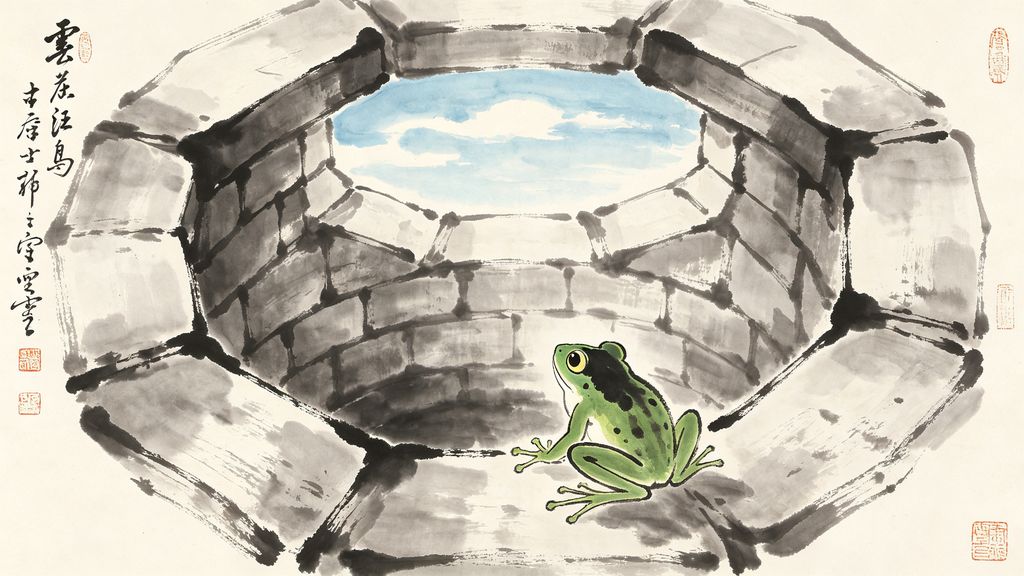
A frog lived at the bottom of a well. One day a sea turtle came to the well's edge, and the frog said: "Look, the sky is only as big as the well's mouth. I am the happiest creature!"
The turtle replied: "The sea has no bounds, and the sky is even bigger than the sea. Come out and see how vast the world is." The frog felt embarrassed.
"A frog at the bottom of a well" describes someone with narrow vision and little experience. The world is huge — read more, travel more, meet more people, and we will never be frogs in a well.
A short tale: a frog lived in a dry well. Every day it looked up and thought the sky was only as big as the well mouth, and it was content. One day a sea turtle passed by and told the frog how vast the ocean was. The frog did not believe it: "The sky is only well-mouth sized; how big can the sea be?" The turtle described the ocean, and only then did the frog realise how small it was.
The idiom "frog at the bottom of a well" comes from this story, describing people of narrow vision and shallow experience who take the little sky they see for the whole world.
Usage is flexible: "he is like a frog in a well, thinking his city is the best place on earth", or self-deprecatingly "I used to be a frog in a well; only after going abroad did I learn how big the world is." It reminds people to stay humble and keep exploring.
The source is Zhuangzi, Autumn Floods. The turtle describes the sea: "a thousand li is not enough to measure its breadth, a thousand ren not enough to reach its depth." Zhuangzi point: understanding has limits; true wisdom is knowing your own ignorance.
In English, "a frog in a well" is used as a loan translation, or you can say provincial or narrow-minded. When Chinese friends call someone a well frog, it is usually a friendly nudge, not a harsh insult.
For learners: learning Chinese, like seeing the world, needs an ever-widening horizon. Reading varied topics, chatting with people from other countries and travelling to unfamiliar cities all widen your well mouth.
To remember this idiom, picture the frog sitting at the bottom of the well, seeing only a round patch of sky. The image reminds us: what you think you see may not be all there is - beyond the well mouth lies an ocean. Stay curious, listen more, see more, travel more, and you will find the world far vaster than you imagined.
Put the idiom in a language-learning context: whenever you feel "my Chinese is already good", think of the well frog - Chinese vocabulary, idioms, dialects and cultural contexts are an ocean, never fully learned. Keeping an "I still have far to go" mindset brings the fastest progress, matching the Chinese saying "modesty brings progress".
A cross-cultural tip: to use this idiom lightly, self-deprecate - "I used to be a well frog, now I have seen the world" - self-mockery is always safe. To praise someone, say "you are no well frog - you are well travelled." Knowing when to use it on yourself versus on others keeps the idiom appropriate.
A general method for idioms: put each one into "scenario sentences" and repeat. Having learned "well frog" today, try "I used to think Chinese was as simple as HSK6 - what a well frog I was." One idiom, three scenario sentences, and it sticks. After 500 common idioms, your Chinese expression clearly jumps a level.

