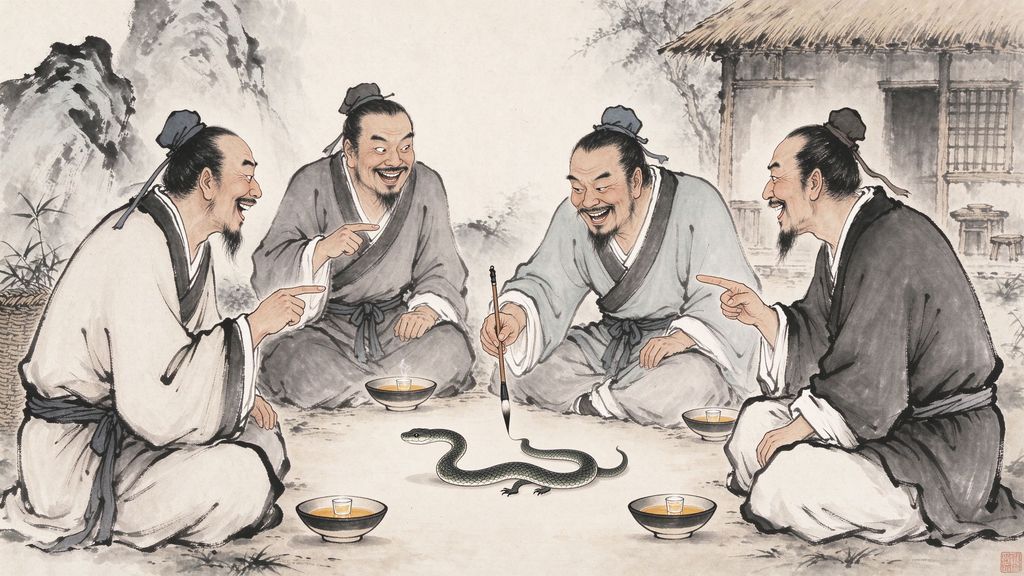
Long ago in the state of Chu, a man rewarded his retainers with a pot of wine after an ancestral sacrifice. Too many people, too little wine - they agreed: whoever drew a snake on the ground first would drink it.
One man finished fastest. Seeing the others far behind, he picked up the pot with his left hand and kept drawing with his right, saying, "I can even add feet to my snake."
While he was adding feet, another man finished his snake, snatched the pot and said: "Snakes have no feet. What you drew is not a snake at all!" And he drank the wine.
The man who added legs ended up with nothing.
The idiom "drawing legs on a snake" means doing something superfluous that ruins the result.
Usage: "The plan is already perfect - do not add more, or you will draw legs on a snake."
The tale tells of a self-clever snake-drawer. Men of Chu raced drawing snakes; wine went to the first finisher.
He finished first but proudly added feet, losing the wine to the second finisher - because snakes have no feet.
From Zhanguo Ce, the classic example of "cleverness spoiling things".
"Huà shé tiān zú" means: doing superfluous things that spoil good results. It reminds us: knowing "just right" is important wisdom.
Today it criticises: piling on layers until simple becomes complex; adding unnecessary "highlights" to finished work.
It also advises speakers: stop when said enough. If a paragraph suffices, do not use ten; if one word works, do not stack adjectives.
For learners it says: learn subtraction in expression - remove the superfluous, and essence remains.
Remember: snakes need no feet; matters need no extras. Doing fewer unnecessary things makes life cleaner.
The tale has a modern version: many people, writing articles or plans, keep "adding a bit more", piling until the core is lost.
Actually good work is often made by subtraction: delete extra sentences, remove extra design; essence remains.
Chinese expression is the same: if one sentence suffices, never use two. Simple, clear, accurate - that is the best Chinese.
In product design today there is a classic case: apps pile on features until users are lost; articles grow long until readers lose patience. Great designers do subtraction: remove unnecessary features, perfect the core experience. This matches Chinese painting - blank space creates mood. In Chinese expression: dare to delete extra words, dare to say "enough". When you learn to leave blank space, your expression gains artistry.
Remember: "dà dào zhì jiǎn" - the greatest truth is the simplest. Work, speech, writing - the simpler, the more powerful. That is the modern wisdom of not adding feet to snakes.
One-sentence summary: act with measure, speak with restraint. Knowing when to stop is a rare skill of maturity.

