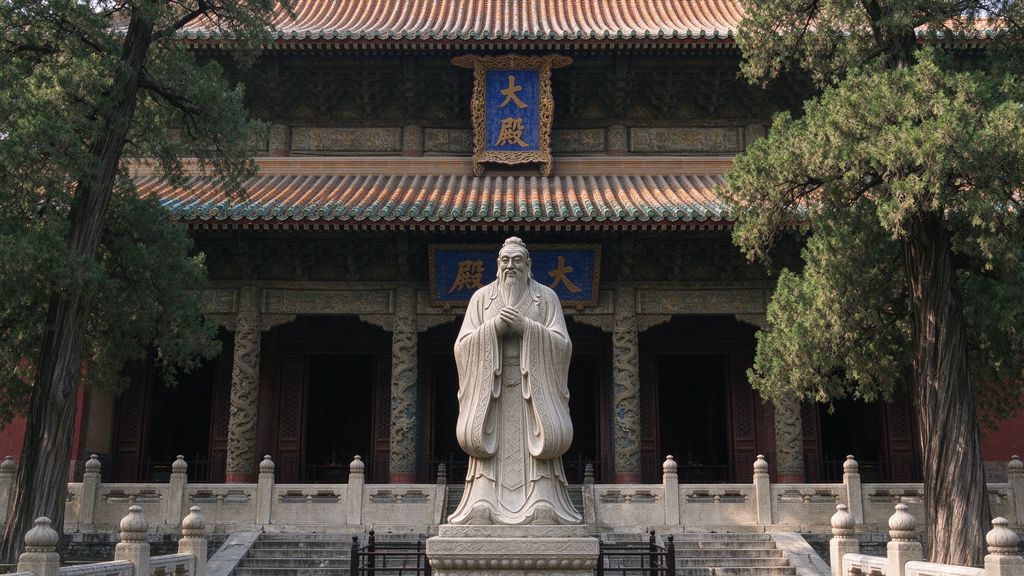
Confucius (551-479 BC), born Kong Qiu in Lu (today Qufu, Shandong), is China greatest thinker and educator.
Core ideas: ren (benevolence - loving people) and li (ritual propriety - social norms), with "do not do to others what you would not want done to yourself", ruling by virtue rather than force.
Education: "education without discrimination" - he accepted 3,000 disciples, 72 of them masters, breaking the aristocratic monopoly on learning.
The Analects, his recorded sayings, has been required reading for two millennia; lines like "learn and practise often" and "among three walkers there must be my teacher" still echo.
Global reach: Confucius Institutes teach Chinese worldwide; the cultures of Japan, Korea and Vietnam are deeply rooted in Confucian tradition.
Today in Qufu: the Three Kongs (Temple, Mansion and Forest) are a UNESCO site; the annual memorial ceremony falls on his birthday, September 28.
Confucius influence extends far beyond China borders. For over two thousand years his thought spread across East Asia, becoming a cornerstone of Eastern civilisation.
In Korea, the Analects was required reading for scholars for centuries. Traditional education values etiquette, respects teachers and filial piety - ideas that trace back to Confucianism.
In Japan, Confucian thought shaped social order and national character: people value hierarchy and politeness, group spirit and respect for seniors - clear Confucian marks.
In Vietnam it is equally deep-rooted: the civil examination system ran for over eight hundred years, literati took pride in Confucian classics, and folk customs still keep many Confucian rites.
Where lies the charm? It answers humanity most basic questions: how to get along with others, how to build a harmonious society. His answer: ren and li - love people, keep ritual.
His "do not impose on others what you do not desire" is seen as the golden rule of common morality. In 1993 it was written into the Declaration Toward a Global Ethic as a principle all humanity should follow.
Today Confucius Institute signs appear on streets of New York, London, Paris. Foreigners learning Chinese and understanding China often start with Confucius.
Confucius himself became a cultural icon: his statue stands at many universities worldwide; his birthday (September 28) is celebrated as Teachers Day in some regions.
A teacher from twenty-five centuries ago still teaches today - that is Confucius, a teacher belonging to all humanity.
For Chinese learners, understanding Confucius has a special bonus: his principles are often the underlying logic of how Chinese speak and act. Politeness, face, and order of seniority all relate to Confucianism. When you visit a Chinese home, elders begin eating first - that is li; when a friend helps you and you say thanks, that too shows li. Reading Confucius, you learn not only Chinese but the reasoning behind Chinese-style courtesy. That is why Confucius Institutes worldwide still begin with Confucius.
Learn the Analects, read China.

