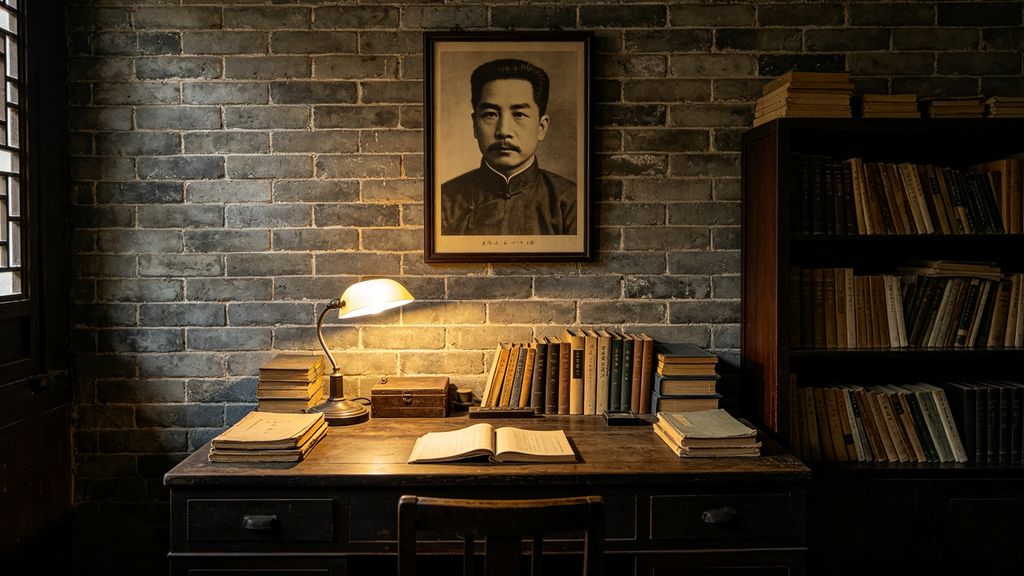
Lu Xun (1881-1936), born Zhou Shuren in Shaoxing, Zhejiang, was the founder of modern Chinese literature, hailed by Mao Zedong as the standard-bearer of China's cultural revolution.
From medicine to letters: Lu Xun studied medicine in Japan, but a lantern-slide showing Chinese crowds apathetically watching their compatriots executed during the Russo-Japanese War so shocked him that he abandoned medicine to awaken his countrymen with words.
Masterworks: the story collections Call to Arms and Wandering (including Diary of a Madman, The True Story of Ah Q and Kong Yiji), the essays of Dawn Blossoms Plucked at Dusk, and reams of piercing essays.
Famous lines: "Fierce-browed I defy a thousand pointing fingers; head bowed I serve the children"; "There was never a road in the world, but when many people walk it, a road is made"; "Either burst out in silence, or perish in silence."
Lu Xun is advanced material for Chinese learners: terse, forceful, satirical. Read him and you will understand first-half-20th-century China. The Lu Xun Museum in Beijing and his hometown Shaoxing are both worth visiting.
Lu Xun (1881-1936), original name Zhou Shuren, is one of the greatest modern Chinese writers, called the "soul of the nation". His essays cut like knives.
Born in Shaoxing, Zhejiang, into a declining family, he studied medicine in Japan, hoping to cure Chinese bodies.
One incident changed him: in a classroom slide show, he saw a Chinese man being executed while Chinese onlookers laughed. He understood: however healthy the body, a numb spirit leaves the nation hopeless.
So he abandoned medicine for writing, determined to awaken the Chinese through words: medicine saves a few; literature changes the human spirit.
In 1918 he published China first modern vernacular short story, A Madman Diary. Through a "madman" it exposed the cannibalising nature of feudal ritual, shocking the literary world.
His most famous collections are Call to Arms and Wandering, including Kong Yiji and The True Story of Ah Q. Ah Q "spiritual victory" became a label for Chinese self-reflection.
Beyond fiction he wrote razor-sharp essays satirising social darkness - daggers and javelins aimed at the core.
His words are still quoted: "there is no road in the world at first; when many walk it, a road is made." They encourage countless people walking in darkness.
Mao Zedong praised him: "Lu Xun bones are the hardest; he has not a trace of servility or flattery." The highest tribute to his character.
Today his works are required reading in Chinese middle school textbooks. Every Chinese student studies Lu Xun.
He has been gone nearly a century, yet his thought stays young. Reading Lu Xun is the best way into modern China.
"Frowning coldly at a thousand accusing fingers, bowing gladly as a willing ox" - never yield to enemies, give all to the people. That is Lu Xun, a Chinese who always stands straight.
Reading Lu Xun is reading an era, not just a writer. Understand him, and you understand China today.
May your Chinese-learning road be one Lu Xun once walked.

