In 1406 the Yongle Emperor decided to move the capital from Nanjing to Beijing and ordered a new imperial palace built there - the Forbidden City. The project took 14 years, about 100,000 craftsmen and a million labourers.
Materials came from across the empire: golden nanmu timber from the deep forests of Sichuan and Yunnan; stone from Fangshan near Beijing (the largest block weighs over 200 tonnes); bricks and tiles fired in Linqing, Shandong and Suzhou, shipped north on the Grand Canal.
Architectural genius: the palace faces south on a central axis with strict symmetry and 9,999.5 bays (over 8,700 survive). The timber frames are joined by mortise and tenon - not a single nail - yet shrug off earthquakes; the Forbidden City has survived many great quakes.
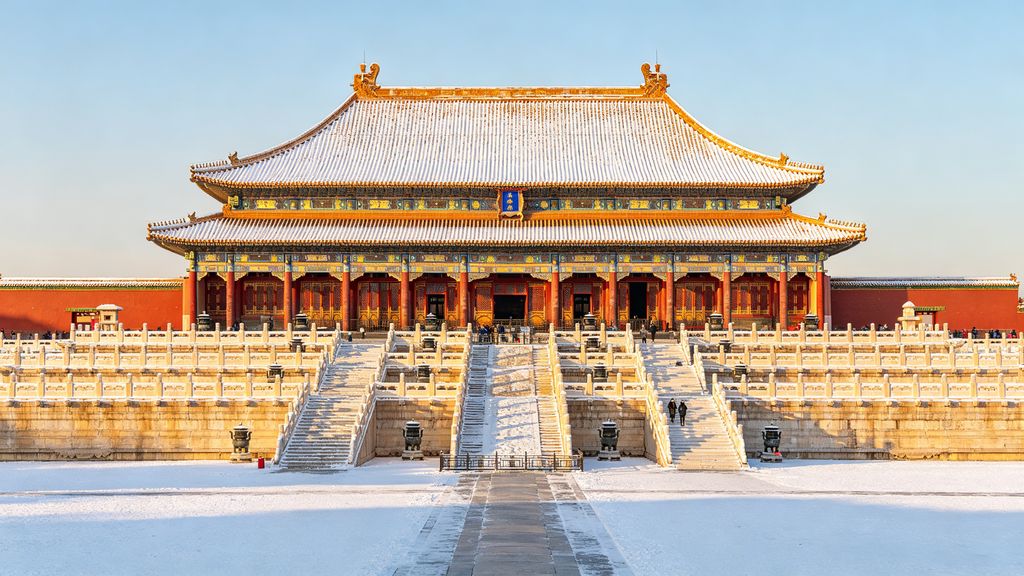
Colour and symbol: golden glazed tiles signify imperial power (in the five elements, earth is yellow); red walls signify festivity and majesty. The Hall of Supreme Harmony, the tallest building in the complex, hosted coronations, imperial weddings and investitures.
Today the Forbidden City (the Palace Museum) welcomes nearly 20 million visitors a year - the most-visited museum on Earth. After six centuries it still stands proud on Beijing's central axis.
The Forbidden City, today the Palace Museum, stands in central Beijing - the largest and best-preserved ancient palace complex on earth.
In the fourth year of Yongle (1406), the Yongle emperor moved the capital from Nanjing to Beijing and ordered construction. The project lasted fourteen years, completed in 1420.
It mobilised one hundred thousand craftsmen and over a million labourers. Timber came from deep forests of Sichuan and Hunan; stone from Fangshan near Beijing, the heaviest weighing three hundred tons.
In winter, workers poured water to freeze the ground and moved giant stones on rollers - a single block might take months to deliver.
The timbers were mostly nanmu and fir. Logs were floated down rivers from mountains thousands of li away to Beijing - a colossal operation.
The complex covers 720,000 square metres with over nine thousand rooms, ringed by a ten-metre wall and a moat over fifty metres wide.
Its layout embodies "unity of heaven and man": on the central axis the Hall of Supreme Harmony, Hall of Central Harmony and Hall of Preserving Harmony were for imperial affairs; the rear palaces for imperial life.
The Hall of Supreme Harmony, the largest, popularly the "throne hall", hosted grand ceremonies. Marble steps, bronze cranes and turtles before it all symbolise auspiciousness.
The name carries meaning: "zi" refers to the Purple Star (heaven emperor abode); "jin" means forbidden. The Forbidden City is "heavenly palace, earthly forbidden ground".
From 1420 to 1911, twenty-four Ming and Qing emperors lived here for 491 years. Countless events that changed Chinese history happened within.
In 1925 the Palace Museum opened to the public. Today it welcomes over fifteen million visitors yearly - the world most visited museum.
In 2015 it celebrated six hundred years. It belongs not only to China but to all humanity heritage.
The three characters "Forbidden City" represent not just architecture but six centuries of Chinese history, art and wisdom.

