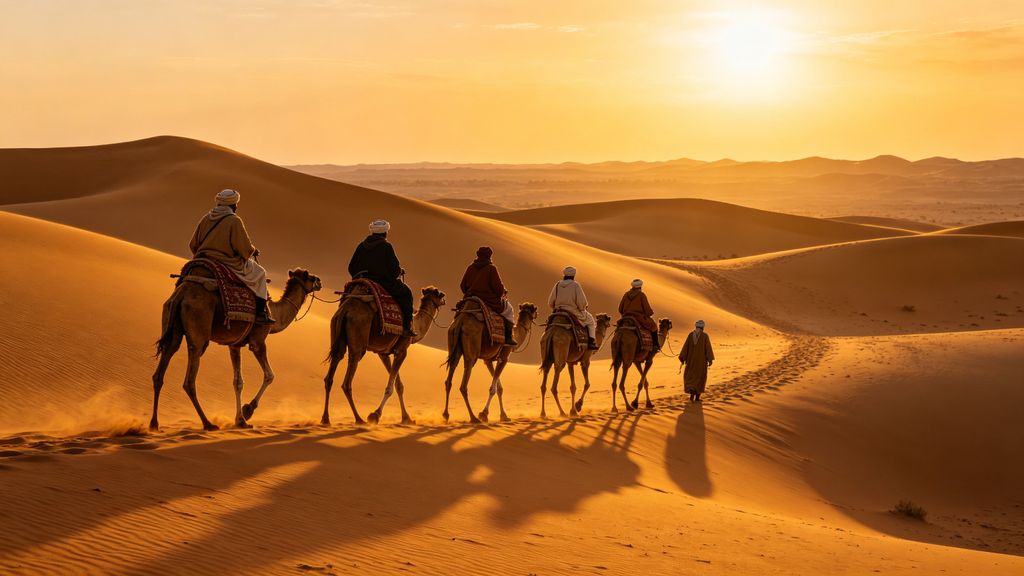
In 138 BC, Emperor Wu of Han sent Zhang Qian west to seek an alliance against the Xiongnu nomads. Leading more than a hundred men, Zhang Qian was captured by the Xiongnu just past Gansu - and held for thirteen years.
During captivity the Xiongnu forced him to marry and have children, yet he always kept the Han envoy tally hidden. Escaping after thirteen years, he continued west to Dayuan, Kangju and the Yuezhi.
The Yuezhi had settled into peaceful life and had no wish for revenge, so the mission failed - but Zhang Qian returned with priceless intelligence about the western kingdoms: geography, products, armies and customs. For the first time, Han China could "see" the West.
In 119 BC Zhang Qian travelled west a second time, laden with silk and gold, building ties with Wusun and Dayuan. Envoys and caravans followed in both directions, and the Silk Road was truly open.
The historian Sima Qian called his feat "chiselling open" (zaokong) a road. The Silk Road later linked Chang'an with Rome as the great artery of East-West exchange - and it all began with one man's lonely journey west.
Over two thousand years ago, a Chinese envoy rode west from Chang An with more than a hundred men. That journey opened a world-changing road - the Silk Road. His name: Zhang Qian.
In 138 BC Emperor Wu sent Zhang Qian to the Western Regions to ally with the Dayuezhi against the Xiongnu. Halfway, the Xiongnu captured him and held him for ten years.
For ten years he never forgot his mission. After escaping, he did not head home but continued west, completing the journey and finding the Dayuezhi.
Though the Dayuezhi declined to ally, Zhang Qian brought back geography, products and customs of the western states - giving China its first real knowledge of the West.
In 119 BC he went again, with over three hundred men and much silk and gold, visiting Wusun and other states and strengthening ties.
His two journeys opened the "gate" from the Central Plains to the West. Thereafter envoys came and went, trade flourished.
Chinese merchants carried silk, tea and porcelain west; western grapes, walnuts, pomegranates and carrots entered China - transforming the Chinese table.
His route expanded into the Silk Road across Eurasia: from Chang An east to Rome west, over seven thousand kilometres.
His achievement is called "zaokong" - cutting an unprecedented road. Sima Qian gave him a biography in the Records of the Grand Historian.
The Silk Road was not only trade but culture: Buddhism, music, dance and glassware entered China; papermaking and silk travelled west.
Today China Belt and Road Initiative reconnects this ancient route, and Zhang Qian name is raised worldwide again.
Zhang Qian spent over twenty years fulfilling his mission. One man persistence changed the course of Eurasian history.
The meaning of "envoy" is building bridges. The bridge Zhang Qian built has stood over two millennia - and still works today.

