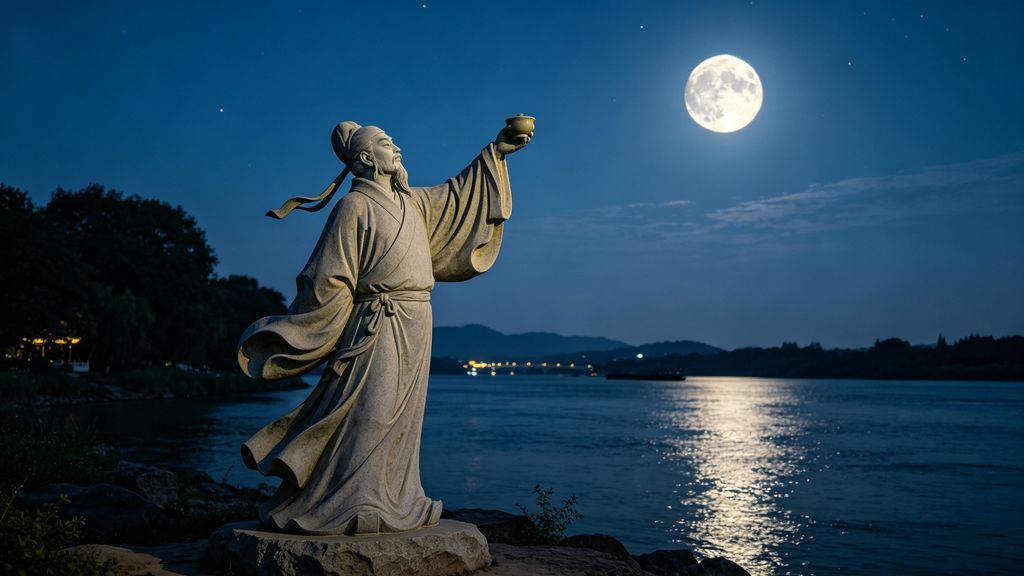
Li Bai (701-762) was the greatest Romantic poet of the Tang dynasty, leaving over a thousand poems and earning the title "Immortal Poet".
Signature works: "Quiet Night Thought" ("I raise my head and watch the moon, lower it and think of home"), "Bring in the Wine" ("Heaven gave me talent; it must be used"), and "Gazing at Lushan Waterfall" — learned by heart by every Chinese child.
A legendary life: born in Suyab (today in Kyrgyzstan), he roamed half of China with a sword in youth, served briefly at the Tang court as a Hanlin academician, then left over his ungovernable spirit.
The charisma: a lover of wine, the moon and swordsmanship — legend says he drowned reaching for the moon's reflection. History doubts it, but the romantic ending fits the "Immortal" perfectly.
World reach: his poems exist in dozens of languages and influenced Western modernists like Ezra Pound; in 2020, a crater on Mercury was named after him.
"Immortal poet" Li Bai is the most dazzling poet of ancient China. One of the most frequent images in his poetry is the moon.
He wrote over three hundred moon-related poems. He loved it, questioned it, invited it, even wanted to "pluck it from the ninth heaven". The moon was his friend in loneliness and wing of imagination.
The most famous is Quiet Night Thought: "bright moonlight before my bed, I take it for frost on the ground. I raise my head to gaze at the bright moon, lower it and think of home." Twenty characters capturing a traveller longing; even three-year-olds recite it.
In Drinking Alone Under the Moon he wrote: "raising my cup, I invite the moon; with my shadow we are three." Drinking alone, he invites the moon; with his shadow, three persons - loneliness written so romantically.
A famous legend: drunk, he saw the moon reflection in water, reached to catch it and drowned. Probably untrue, but people believe it - only Li Bai would die for the moon.
Writing the moon, he wrote himself: the moon high and pure, symbolising his noble character; bright and clear, symbolising his open heart.
Today his poems circle the world. Foreign readers of "raise head to the bright moon" also think of home - the moon is poetry shared by all humanity.
To learn the most famous Chinese poem, start with Quiet Night Thought. Twenty characters; you feel the charm of Chinese characters and Chinese romance.
Li Bai is the immortal poet; the moon is the eye of his verse. Poetry and moon form the most beautiful scenery of Chinese literature.
The moon in Chinese culture is almost synonymous with homesickness, and no poet tied them tighter than Li Bai. Today Chinese seeing the full moon recall Quiet Night Thought; foreign learners of Chinese almost all memorise it. One twenty-character poem links Chinese people with all moon-lovers worldwide. On some moonlit night, recite Quiet Night Thought softly to the moon - you will find both poetry and moonlight are beauties that cross languages.
Where there is moonlight, there is poetry; where there is poetry, there is China.
Where moonlight falls is home; where poetry rises is China.
Reading Li Bai is reading the most romantic part of the Chinese heart.

