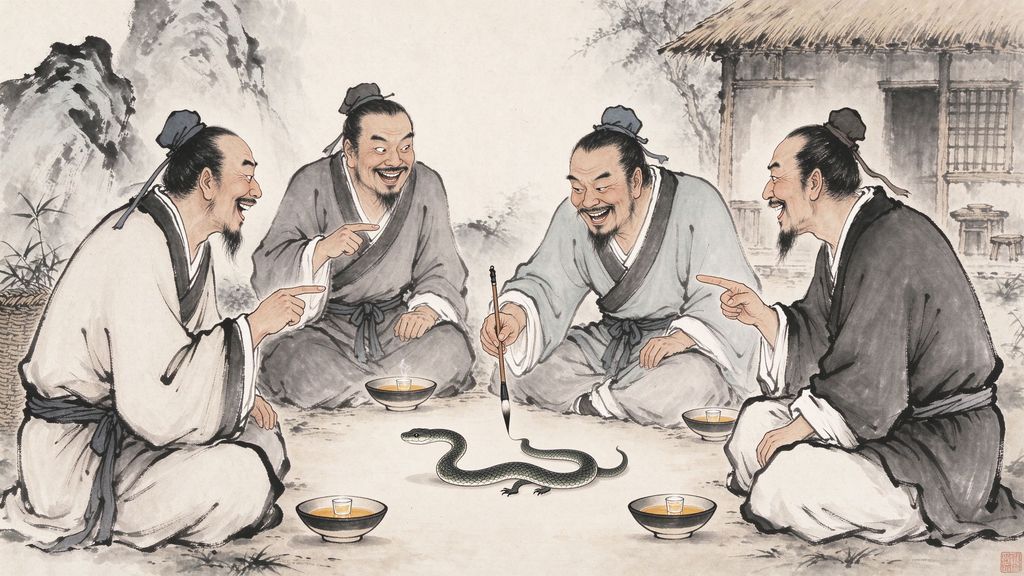
Long ago, friends competed to draw a snake — whoever finished first won a pot of wine. One man drew fastest. Holding the wine, he saw others still drawing and said: 'I can even add feet to the snake!'
So he drew four feet on his snake. But snakes don't have feet. Another man finished then and said: 'Snakes have no feet — what you drew is not a snake. I win.' And he drank the wine.
'Hua she tian zu' (drawing legs on a snake) means doing something unnecessary that ruins the result. For example, you've written a correct answer, then you add useless words and make a mistake. Do things just right — no extra moves.
The story is set in the state of Chu during the Warring States era: a host had wine for several guests but only one jar. They agreed: draw a snake on the ground, and the fastest wins the wine. One man finished first; snake done, he picked up the jar with his left hand while drawing with his right: "I can add feet to it!" Before he finished, another man completed his snake, snatched the jar and said: "Snakes have no feet. With feet, it is not a snake." He drank it all.
The idiom means adding feet to a drawn snake - doing something unnecessary that spoils the result. It describes overdoing things until they backfire.
Usage: the report is already complete; adding irrelevant charts would be drawing feet on a snake. A plan is tight enough; piling on extra steps only slows it down. It is often interchangeable with "doing something superfluous".
The deeper point: the standard for doing things is appropriateness, not quantity. Knowing when to stop is as valuable as doing more - wisdom that applies to work and life.
English: "to gild the lily" means almost the same - over-decorating something already perfect and ruining it. Say: "Adding those extra slides would be gilding the lily." Tell the Chinese snake story alongside it.
Memory trick: picture the odd combo "snake + feet". Snakes have no feet; with feet it stops being a snake. Whenever you feel like doing "a little more", ask: is this necessary, or am I adding feet to a snake?
Remember it with a question: does a snake need feet? No. Then does your plan need "a little more"? Distinguish necessary from superfluous and you will avoid drawing feet on snakes. Doing things just right requires more wisdom than piling on more.
Using this idiom in essays and chats makes your Chinese vivid instantly: "let us simplify the plan further - no drawing feet on the snake", or "he already apologised and you keep repeating it - is that not adding feet to a snake?" Mastering idioms is a key step from speaking Chinese to speaking it well.
During the Warring States, in the state of Chu, someone who finished an ancestral rite rewarded his servants with a pot of wine. One pot, too many people - someone proposed: "let us draw snakes on the ground; whoever finishes first gets the wine."
The fastest drew a complete snake, picked up the pot, then proudly said: "I can add feet to it!" So he drew feet on the snake.
At that moment another man finished his snake, snatched the pot and said: "Snakes have no feet; adding feet makes it not a snake. The first to finish is me!" He drank the wine.
The feet-adder, precisely because of the extra feet, lost the wine that was already his. The story comes from Zhanguo Ce, one of China most famous idiom tales.
"Huà shé tiān zú" means: doing superfluous things that spoil the result. It reminds us to stop at the right point - do not overdo it.
Today it criticises two cases: overdoing tasks until simple things turn complicated; and overexplaining until clear words drown in chatter.
For learners the imagery is strong - remember "snakes have no feet" and you will never misuse it.
In life too: often doing fewer unnecessary things is wiser than doing more. Four characters, the best reminder.

