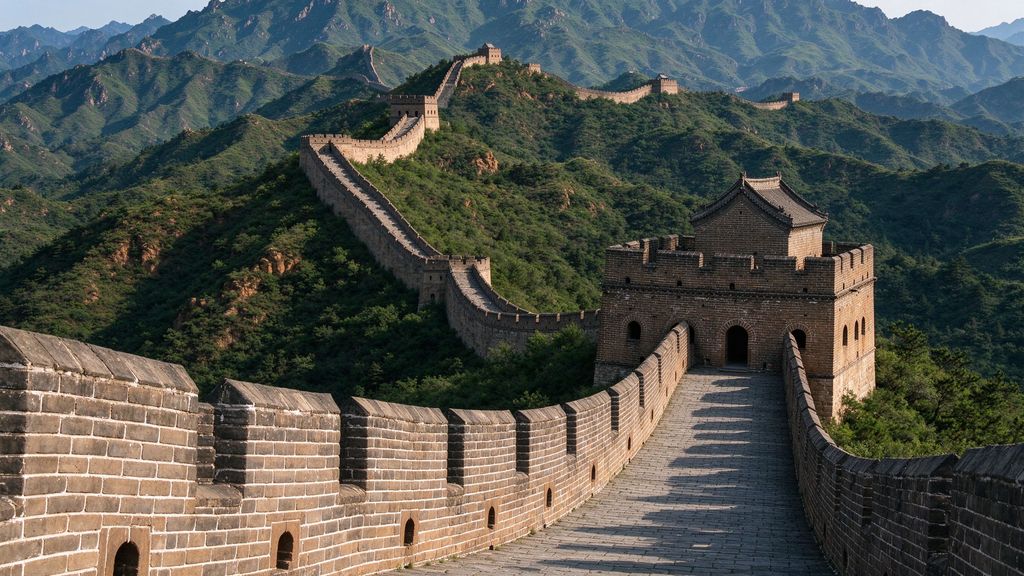
The Great Wall is not one wall but a defense system stretching over 20,000 km — walls, beacon towers, passes and garrison forts across 15 provinces.
History: beginnings date to the Warring States (7th century BC); Qin Shi Huang linked existing walls into the "Ten-Thousand-Li Wall". What you see today is mostly Ming dynasty (14th-17th century).
Beacon signals: smoke by day, fire by night, passed tower to tower — intelligence could cross hundreds of kilometers in a day. Ancient China's telegraph.
Famous sections: Badaling (most classic, most crowded), Mutianyu (scenic, fewer crowds), Simatai/Jinshanling (wild-wall photography), and Jiankou (steep, not open — don't climb).
Heritage: a UNESCO site since 1987. "You're not a real man until you've climbed the Great Wall" — Mao's line still graces the Haohan Slope stele.
The Great Wall is China most spectacular structure and one of the world most famous landmarks. One of its earliest military functions was the beacon-tower signalling network.
Beacon towers are tall platforms on the Wall, about every five kilometres, built on high open ground. Their job: to relay alarms quickly when enemies came.
How? By day they raised thick smoke, "beacon smoke" or "wolf smoke"; by night, bright flames, "beacon fire". One tower lights, the next sees and lights in turn, station after station.
The speed was astonishing: in the Han dynasty, enemy news from a thousand li away could reach the capital within two or three days - the fastest "message network" in an age without telephones.
Why "wolf smoke"? One theory: ancient soldiers burned wolf dung, whose smoke rose straight and resisted wind, ideal for signalling.
Beacon towers served in peacetime too: relaying imperial documents, escorting envoys, housing passing troops - the Wall "information centres".
The famous story "beacons amusing the lords" warns of false alarms: King You of Zhou lit beacons to amuse his concubine; when real alarm came, no one believed - and the state fell. Alarms are no joke.
The Ming dynasty was the peak of Wall building. The brick Wall we see today is mostly Ming; the Ming Wall alone had over a thousand beacon towers.
The Wall is not just a wall but a complete defence system: walls, passes, watchtowers, beacons, garrisons working together. Beacons were its "nervous system".
Can the Wall really be seen from space? From orbit it is hard - too narrow. But its greatness is not "visibility" but its length and genius.
Today no smoke rises, yet "beacon fire" lives on in Chinese: urgent war news is "fenghuo"; repeated raids are "wolf smoke on all sides".
Walking the Wall past tower after tower, imagine centuries ago flames leaping, passing the message a thousand li in a chain.
The Wall is Chinese pride; beacons are its eyes. Read the beacons, and you read the Wall wisdom.
He who has not reached the Great Wall is no true man - come walk its beacon towers.

