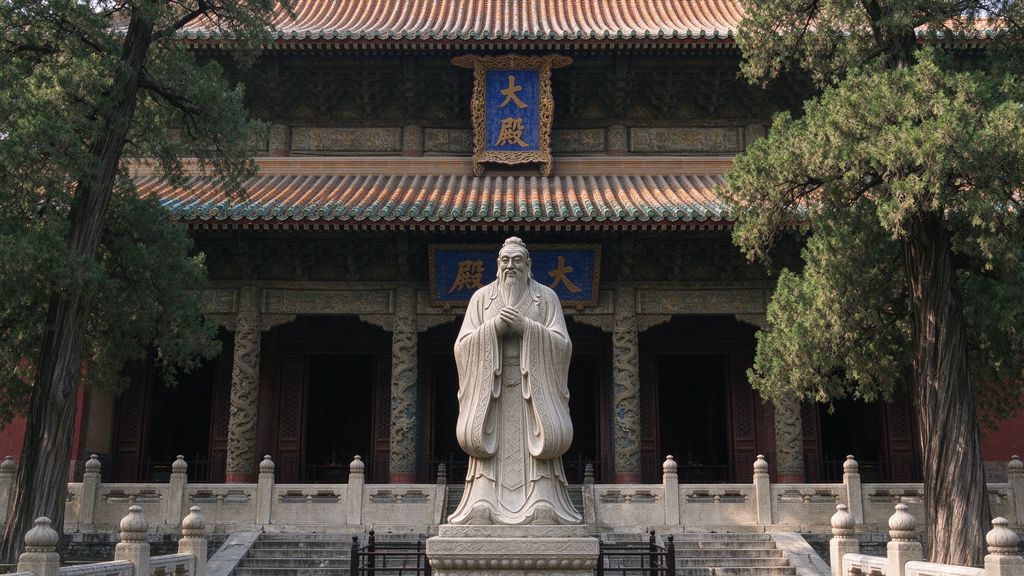
Confucius is China's most famous thinker, who lived over 2,500 years ago. He was neither emperor nor general, yet he influenced China for more than two thousand years.
His greatest contribution was education. He was the first to say that rich or poor, everyone deserves to learn — 'you jiao wu lei' (education without discrimination). He had three thousand students, seventy-two of them most renowned.
His sayings were collected by his students into a book called the Analects (Lunyu). 'Ji suo bu yu, wu shi yu ren' means: do not do to others what you would not want done to yourself. Today, Confucius Institutes around the world teach Chinese language and culture.
First, who is Confucius? His personal name was Qiu, courtesy name Zhongni, from the state of Lu in the Spring and Autumn period (551-479 BC), now Qufu, Shandong. A thinker and educator, he founded Confucianism and is honoured as the "Supreme Sage and Foremost Teacher".
His core ideas in a few words: ren - the heart that loves others, the starting point of morality; li - social order and norms, the standard of action; zhongyong - moderation, doing things just right without excess. He championed "education for all" regardless of wealth or rank and is said to have taught 3,000 students, 72 of them renowned sages.
His dialogues with students were compiled into the Analects. Lines like "Is it not a pleasure to learn and practise what you have learned?", "When three walk together, one of them can be my teacher" and "Do not do to others what you would not want done to yourself" remain everyday Chinese speech 2,500 years later. Travelling in China, you will see Analects quotes in schools, offices and sights.
His influence reaches far beyond China. Confucianism shaped the etiquette and values of Korea, Japan, Vietnam and other East Asian cultures. Today Confucius Institutes and classrooms around the world teach Chinese language and culture.
Visit the "Three Kongs" in Qufu: the Temple (for worshipping Confucius, grand architecture), the Mansion (where his descendants lived, on a vast scale) and the Forest (family cemetery with towering ancient trees). All three are UNESCO World Heritage - worth a full day.
A question worth pondering: why does a teacher from 2,500 years ago still matter? Because the questions he raised - how to treat people, how to learn, how to become a better person - face every generation. Understanding Confucius is understanding the base colour of Chinese values.
A practical tip: with limited time, visit the Temple and Mansion (at least 4 hours); the Forest is north of town and needs half a day. Rent the bilingual audio guide - otherwise you may see buildings without understanding them. On September 28 each year, Qufu holds a solemn ceremony honouring Confucius birthday - worth a special trip.
Confucius is closer to modern life than you might think: Chinese respect for elders, cherishing children, valuing harmony and putting yourself in others shoes all trace back to his thought. Foreign friends often call Chinese people polite and relationship-minded - those impressions come from Confucian culture. Understanding Confucius is a key to Chinese society - not memorising quotes, but seeing how these values shape everyday life today.

