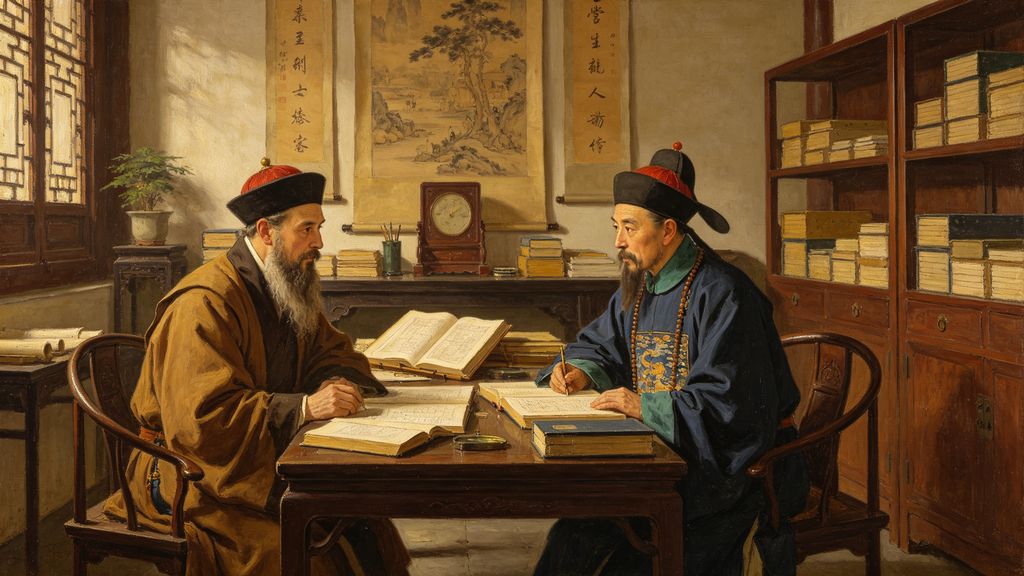
Matteo Ricci (1552-1610) was an Italian Jesuit missionary and scholar. He came to China in 1583, first learning Chinese in Macau and Zhaoqing, then went to Nanjing, and finally reached Beijing in 1601, receiving an audience with the Wanli Emperor—the first Western missionary to enter the Beijing court. He lived in China for 27 years, died in Beijing, and was buried where the municipal party school is today.
Matteo Ricci was a smart man. He knew that to get Chinese people to accept Catholicism, he had to respect Chinese culture first. So he dressed in Confucian robes, wore a scholar's hat, learned Chinese, read the Four Books and Five Classics, and gave himself a Chinese name "Li Madou," art name "Xitai." He became friends with many Chinese scholar-officials, the most famous being Xu Guangqi.
Matteo Ricci and Xu Guangqi translated the first six books of Euclid's "Elements." This was the first Western mathematical work translated into Chinese; the word "geometry" (jihe) was coined by Ricci and Xu. Point, line, plane, right angle, acute angle, obtuse angle—all these terms in today's math textbooks were translated back then.
Matteo Ricci also drew the first Chinese world map—"Great Map of Ten Thousand Countries." On this map, Chinese people learned for the first time that the world is round, and China is only part of five continents. This caused a big shock at the time—Chinese people had always thought China was the center of the world.
Matteo Ricci was the first person in East-West cultural exchange. He brought Western mathematics, astronomy, geography, music, and painting to China, and also translated Chinese Confucian classics into Latin to introduce to Europe. He wasn't just here to preach—he was truly doing cultural exchange. Today, Matteo Ricci's tomb is still in Beijing, and many people visit to commemorate this pioneer of East-West exchange.
Matteo Ricci, Italian Jesuit who reached China during the Ming dynasty - the first Western scholar to enter the Chinese court and earn deep respect from Chinese literati.
His arrival: in 1583 he entered China proper from Macao. Knowing direct preaching would fail, he first learned Chinese, wore Confucian robes and made friends, opening China door with knowledge and friendship.
His scholarship: he brought not only religion but Western astronomy, mathematics and geography - drawing the first Chinese world map, Kunyu Wanguo Quantu, revealing to Chinese readers a round world of five continents.
His collaboration: with Chinese scholar Xu Guangqi he translated Euclid Elements, introducing Western logic and science. Xu called him "a learned gentleman of vast knowledge".
His achievement: in 1601 he was permitted to settle in Beijing. He became the first standard-bearer of "Western learning spreading East", opening a golden age of Sino-European exchange.
Significance: a two-way cultural envoy - he brought Western science to China and true China to Europe through his letters.
Commemoration: his tomb remains in Beijing; he is a landmark figure of Sino-Italian friendship.
For readers: his story shows - true exchange begins not with persuading the other side but understanding it.

