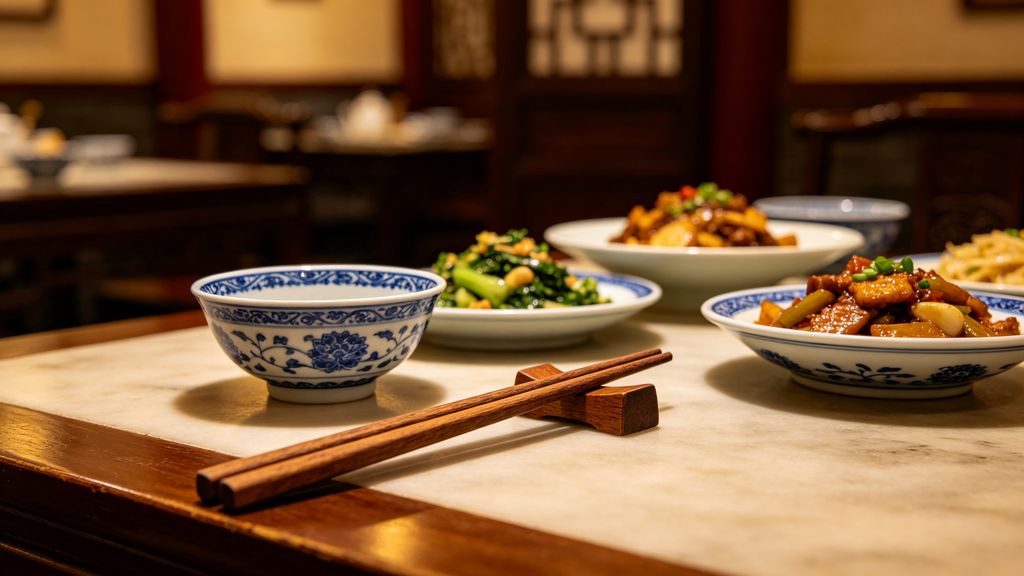
Chinese people have used chopsticks for over 3,000 years. They may look like two simple sticks, but they hold a lot of wisdom.
There are rules of etiquette: never stick chopsticks upright in rice (it resembles incense for the dead), never point at people with them, and never dig around in a dish. Placing them on your bowl means 'I'm full'.
Why do Chinese use chopsticks while Westerners use knives and forks? Some say the Chinese value harmony — no knives at the table feels gentler. Using chopsticks also trains finger coordination. Many foreigners are learning now — do you find it hard?
Chopsticks are the main eating utensils of China, with at least 3,000 years of history. Two small sticks, yet they carry deep culture in every pinch and release.
Technique: the lower stick stays still; the upper moves, working with thumb, index and middle fingers like a clamp. Foreigners often find it hard at first, but a few days of practice brings mastery.
Etiquette (very important): never tap the bowl with chopsticks (beggars do that); never stick them upright in rice (looks like incense for the dead - unlucky); never point at people with them; do not reach across others when picking food; after eating, do not lay them across the bowl. These rules matter most at formal occasions.
Why chopsticks instead of knife and fork? Historians link it to diet structure: Chinese dishes are cut into small pieces suited to pinching, while the West traditionally ate large roasted meat needing knives. Chopsticks embody the Chinese value of harmony - food is gently lifted, not cut.
Fun facts: China invented gong kuai (serving chopsticks) for hygiene; disposable chopsticks are "convenience chopsticks"; Japan, Korea and Vietnam also use chopsticks but with variations - Korea uses metal, Japan tips are pointier.
Visitor tips: restaurants provide chopsticks and spoons; if you struggle, politely ask "qǐngwèn, yǒu dāochā ma?" (do you have a knife and fork?). Mastering chopsticks helps you fit in faster and win Chinese goodwill.
Chopsticks carry a romantic lore: gifting chopsticks wishes friends happiness and togetherness ("two sticks, a pair"); new shops receive chopsticks to "get rich quickly". Next time you buy souvenirs in China, pick a fine pair of chopsticks - practical and a beautiful blessing.
A tip for chopstick beginners: start with big items (a whole piece of tofu, a steamed bun), then graduate to peanuts. Practise five minutes after each meal and within a week you will pinch rice grains. If something drops, say "no problem" and keep going - relax, and the utensils will obey better and better.
A historical footnote: chopsticks appeared as early as the Shang dynasty, possibly for hot food and rituals before becoming daily utensils; Shang bronze chopsticks found by archaeologists prove over 3,000 years of history. Neighbouring countries developed their own traditions - Vietnam pairs chopsticks with spoons, Japan refines chopstick etiquette to an art. Studying chopsticks is studying a cultural bond of East Asian civilisation.

