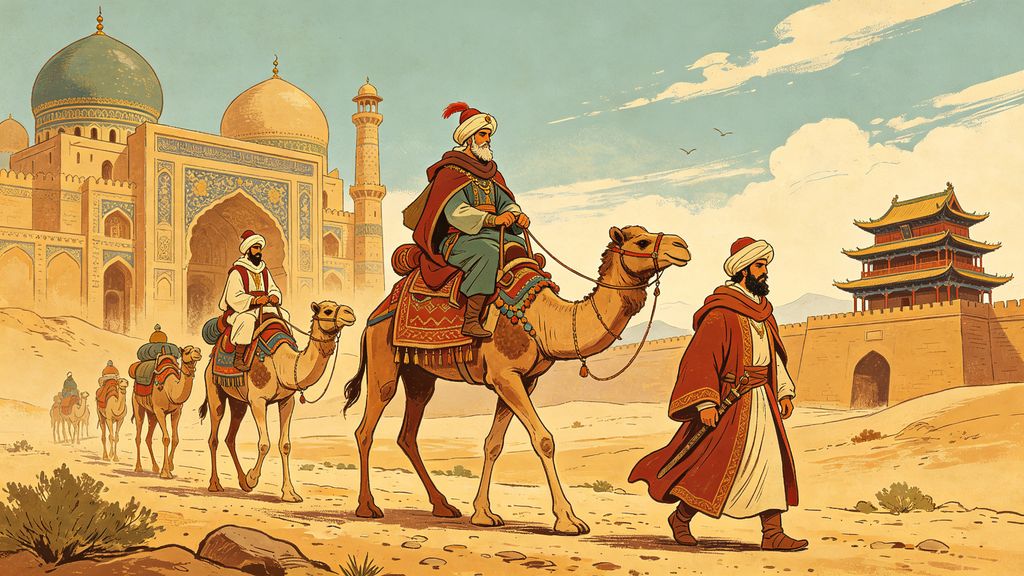
Marco Polo (1254-1324) was an Italian traveler. At 17, he followed his father and uncle along the Silk Road, taking four years to reach Xanadu in 1275, meeting Kublai Khan, founder of the Yuan dynasty. Back then it was the Yuan dynasty, when Mongols ruled China and were relatively open to foreigners—that's how Marco Polo was able to stay in China for 17 years.
Marco Polo served as an official in China for many years, reportedly as governor of Yangzhou for three years. He traveled all over China—Xinjiang, Gansu, Inner Mongolia, Shanxi, Shaanxi, Sichuan, Yunnan, Shandong, Jiangsu, Zhejiang, Fujian. He also visited many countries like Myanmar, Vietnam, and the Philippines. He saw many things Europeans had never even heard of.
Marco Polo left China in 1292. On his return, he was captured in a war and imprisoned in a Genoa jail. In prison, he told his cellmate about his experiences in China; his cellmate was a writer and wrote these stories down—this became "The Travels of Marco Polo" (also known as "Description of the World").
This book caused a sensation in Europe. Europeans learned for the first time that the East had such a wealthy country—using paper money, burning black stones (coal), having beautiful silk, and magnificent cities. Many didn't believe it, thinking he was making it up. But many others were drawn to his descriptions and wanted to go East. Columbus read "The Travels of Marco Polo" and was inspired to sail west—ending up discovering America.
Some people now question whether Marco Polo actually reached China, saying he just heard stories from others. His book doesn't mention the Great Wall, chopsticks, tea, or Chinese characters—things Chinese people use every day. But regardless, "The Travels of Marco Polo" is a milestone in East-West exchange—it was the first time Europeans truly "saw" China.
Marco Polo, the Italian traveller who reached China in the 13th century, whose travels made Europe "see" China for the first time. Was he the first European in China? No - but the most famous.
His journey: in 1271, at 17, he set out with his father and uncle along the Silk Road, arriving after four years at Khanbaliq (modern Beijing) in 1275, meeting Kublai Khan.
His observations: he lived in China 17 years, served as an official, and travelled widely. His book described Hangzhou prosperity, the great port of Quanzhou, paper money and coal - unheard of in Europe.
The debate: many doubt he ever came - he never mentioned the Great Wall, chopsticks or tea. Supporters note details like paper money, courier stations and numbers only an eyewitness could write.
His influence: his book caused a sensation - Europe first learned of a wealthy powerful China, fuelling European desire for the East and indirectly influencing the Age of Discovery.
Significance: he symbolises East-West exchange - one man walking can change how two worlds see each other.
Commemoration: today both China and Italy honour Marco Polo; the Silk Road gained legendary colour through him.
For readers: his story shows - the world is large, but if you set out, one person can bridge two civilisations.

