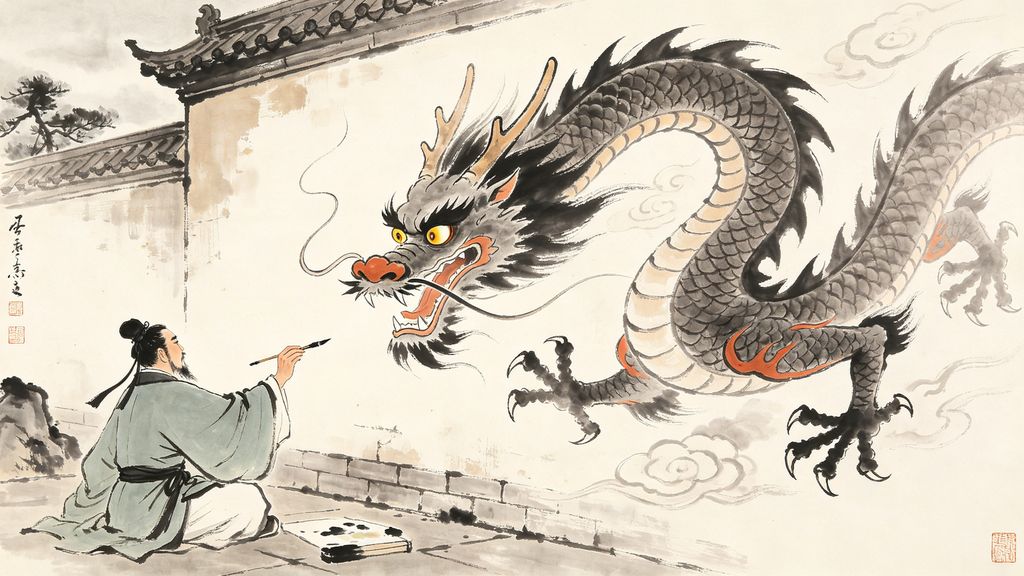
During the Liang dynasty of the Southern Dynasties, there was a famous painter named Zhang Sengyou. He painted four dragons on the wall of the Anle Temple in Jinling, vivid as if they were real. But strangely, none of the four dragons had pupils painted.
People thought this was strange and asked him: "Why don't you paint the eyes on the dragons?" Zhang Sengyou said: "The eyes cannot be painted casually. Once the eyes are painted, the dragons will fly away." Everyone didn't believe him, thinking he was bragging.
Zhang Sengyou had no choice but to pick up his brush and paint pupils on two of the dragons. As soon as he finished, the sky darkened with clouds and thunder; the two painted dragons broke through the wall and flew into the sky. Everyone was stunned.
When the clouds cleared, only the two dragons without eyes remained on the wall—those with eyes had disappeared. Only then did everyone believe what Zhang Sengyou had said was true.
This is the story of "painting the eyes on a dragon." It means adding a brilliant touch at the critical point to make the whole thing come alive. When doing things, the final key step is often the most important—do it well and the whole thing comes alive; do it poorly and all the previous work is for nothing.
The tale: in the Southern Dynasties lived a painter Zhang Sengyou of superb skill. On a wall he painted four dragons, lifelike, yet without eyes.
People asked why no eyes. He said: "with eyes, the dragons will fly away." Nobody believed him, so he dotted eyes on two dragons.
As soon as he did, the miraculous happened: dark clouds gathered, thunder and lightning flashed, and the two eyed dragons broke through the wall and flew into the sky; the two eyeless stayed on the wall.
The story comes from Zhang Yanyuan Tang-era Record of Famous Paintings of Past Dynasties. "Huà lóng diǎn jīng" became one of China most famous idioms.
It means: adding a stroke at the key point makes the whole come alive. It speaks of the power of the key point - one sentence, one detail, often decides success or failure.
Today it praises: the finishing touch of a good essay, the highlight of a good plan, the most moving line of a speech.
For learners it applies to expression: speaking and writing need not cover everything; capturing the few key points clearly is "dotting the dragon eye".
Remember: however well drawn, a dragon without eyes is dead; however much said, words without focus are empty. The key stroke deserves care.
The tale tells us: the key point decides everything. The same words, placed at the vital point, carry power; the same article with a good title attracts readers.
In life we also dot dragon eyes: a sincere word of encouragement may be the stroke a friend needs; a clear small goal may be the key step forward.
Learning Chinese is the same: rather than a hundred words, use one word correctly a hundred times. Find the key point, find efficiency.
"Dotting the dragon eye" is used often at work: a report with a brilliant opening line gets remembered; a plan with a clever highlight wins clients. Chinese critics say a work has "soul" or "spirit" - that is the dotted eye. For learners it reminds: expression is not about many words but accuracy. When one simple, accurate Chinese sentence hits the point, its power beats a hundred pretty ones.

