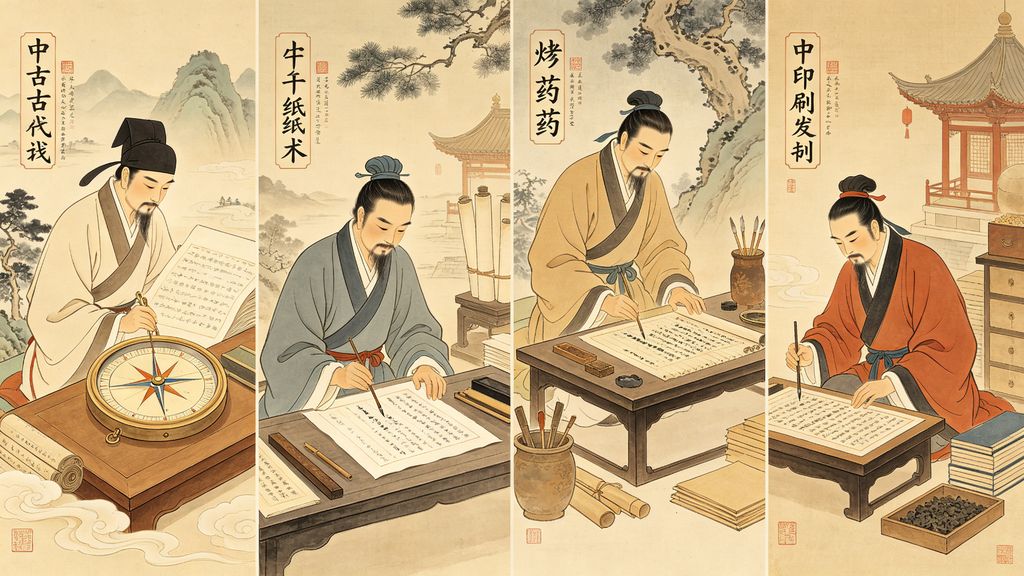
Papermaking, printing, gunpowder, and the compass are known as the Four Great Inventions of ancient China. These four inventions spread to the West via the Silk Road and completely changed the face of the world. British philosopher Bacon said: these three inventions (printing, gunpowder, compass) have changed the whole face of the world—no empire, no religion, no famous person has had greater power and influence on human affairs.
Papermaking was improved by Cai Lun in the Eastern Han dynasty (105 AD). Before paper, Chinese wrote on bamboo slips or silk—heavy and expensive. Cai Lun used tree bark, hemp rags, old cloth, and fishing nets as raw materials to make cheap, good-quality paper. From then on, recording and spreading knowledge became much easier.
Printing started as woodblock printing in the Tang dynasty; Bi Sheng invented movable type in the Song dynasty. Before printing, books were hand-copied—one book took years to copy. With printing, books could be mass-produced, and ordinary people could afford them. This greatly promoted education and the spread of culture.
Gunpowder was invented by Tang dynasty alchemists who were trying to make immortality elixirs, but ended up inventing gunpowder. It was later used in warfare, changing the nature of war. The compass developed from the Warring States period "south-pointer"; Song dynasty started using it for navigation. With the compass, long-distance ocean voyages became possible, leading to the Age of Exploration.
The Four Great Inventions are China's great contribution to world civilization. But it's also worth noting that these inventions didn't fully develop in China—gunpowder was used for fireworks, the compass for feng shui. Instead, after spreading to the West, they became powerful forces for social change. Why? It's worth thinking about.
Ancient China had four great inventions: papermaking, printing, gunpowder and the compass. They changed China - and the world.
First, papermaking. In the Eastern Han, Cai Lun improved it using bark, hemp, rags and fishing nets to make light, cheap paper. Paper made knowledge no longer the privilege of the few.
Before, Chinese wrote on bamboo slips - one book filling several cartloads; or on silk - too costly for ordinary people. Paper was a revolution in information.
Next, printing. Block printing appeared in Sui-Tang times; in the Northern Song, Bi Sheng invented movable type with clay characters that could be reset - four hundred years before Europe.
Printing allowed books in mass production, more readers, fairer examinations. Knowledge entered the "batch age".
Gunpowder was a by-product of alchemists seeking elixirs, who found that saltpetre, sulphur and charcoal mixed explode.
It was first used for festival fireworks and shows, later for war. Reaching Europe, gunpowder and firearms changed warfare and hastened feudalism end.
The compass, earliest called "sinan", was a magnetised spoon-like instrument. In the Song it became a needle-and-dial compass for navigation.
Carried to Europe, it enabled the Age of Discovery: Columbus and Magellan sailed by it. The world map was redrawn.
The four inventions are China great gift to world civilisation. Marx called gunpowder, compass and printing the "three inventions heralding bourgeois society".
Today paper and print have evolved into digital technology, gunpowder powers rockets and engineering, the compass became the GPS in your phone. Their spirit - innovation - lives on.
When in China, see the originals in museums and marvel at ancient Chinese genius.
The four inventions teach us: great civilisations gladly share their best with the world.

