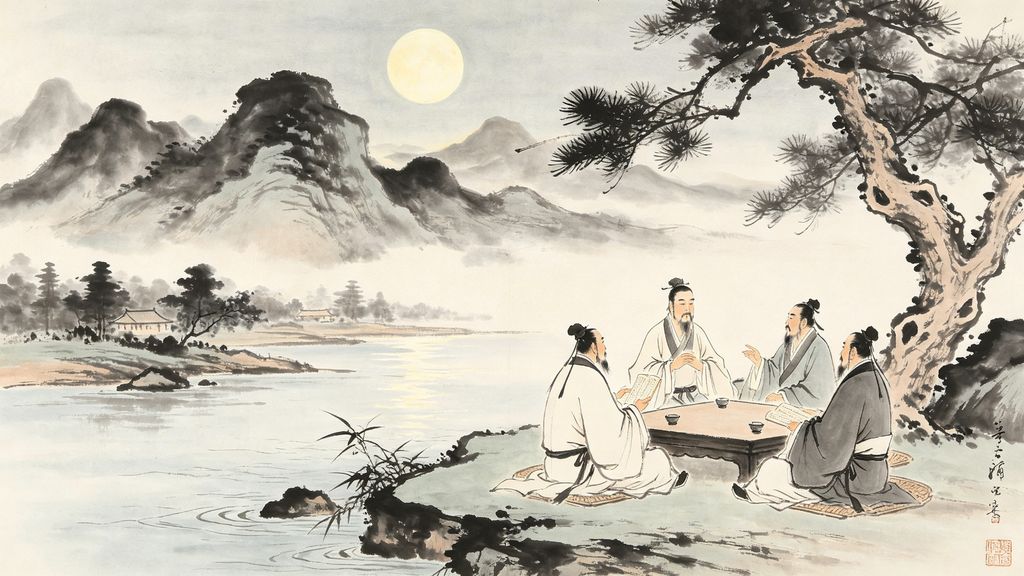
Tang poetry and Song lyrics are two peaks of classical Chinese poetry. The Tang dynasty (618-907) was the golden age of poetry—nearly 50,000 poems by over 2,000 poets have survived. The Song dynasty (960-1279) was the golden age of ci poetry—over 20,000 lyrics by over 1,000 poets have survived.
Tang poetry has many forms: five-character, seven-character, regulated verse, and quatrain. Famous poets include Li Bai, Du Fu, Wang Wei, Bai Juyi, Li Shangyin, and Du Mu. Li Bai's poetry is free and bold—the "Poet Immortal"; Du Fu's poetry is solemn and deep—the "Poet Sage"; Wang Wei's poetry is landscape painting in words—the "Poet Buddha".
Song ci is a new poetic form with lines of varying lengths, more suitable for singing. Ci poetry is divided into graceful and bold schools. The graceful school is represented by Liu Yong and Li Qingzhao, writing about love and emotions. The bold school is represented by Su Shi and Xin Qiji, writing about the nation and the world.
Why are Tang poetry and Song lyrics so great? Because the Tang and Song dynasties were the most prosperous periods in Chinese history—strong economy, flourishing culture, high status for scholars. The imperial exams tested poetry, so all scholars had to write poetry. The whole society valued poetry, which naturally produced great poets.
Today, Tang poetry and Song lyrics are still the first reading material for Chinese children. From first grade, textbooks include Tang poems. "Before my bed lies a pool of moonlight," "Spring morning unawakened, everywhere birds singing"—almost every Chinese person can recite these. Over a thousand years later, these poems still live in our daily lives.
In Chinese literary history, Tang poetry and Song ci are called the "twin jades" - the two most brilliant peaks of Chinese literature.
The Tang dynasty (618-907) was the golden age of poetry. The Complete Tang Poems collects nearly 50,000 poems by over two thousand authors. From emperor to commoner, everyone wrote and read poetry.
Why so prosperous? Strong nation and open culture; the civil exam tested poetry; and Tang people loved life, expressing every joy and sorrow in verse.
The "Four Elites of Early Tang" (Wang Bo, Yang Jiong, Lu Zhaolin, Luo Binwang) opened the way. Wang Bo wrote "a bosom friend within the four seas is a neighbour though a thousand miles apart" while still young.
High Tang was the peak: Li Bai, bold and free, the "poem immortal"; Du Fu, deep and measured, the "poem sage"; Wang Wei, painting in verse, the "poem Buddha".
Mid-Tang saw Han Yu, Liu Zongyuan, Bai Juyi and Yuan Zhen; late Tang, Li Shangyin and Du Mu. Bai Juyi Song of Everlasting Sorrow, about Emperor Xuanzong and Yang Guifei love tragedy, still echoes.
In the Song dynasty, ci replaced poetry as the mainstream. Ci were lyrics set to music with lines of varying length - hence "long-short lines".
Song ci are richly varied: Liu Yong, tender and passionate - "where will I wake from drink tonight? By willow banks, in the dawn breeze and waning moon"; Su Shi, bold and free - "the great river flows east, waves washing away heroes of a thousand ages".
Li Qingzhao, the greatest woman poet of the Song: "seeking, searching, cold and clear, miserable and desolate" - fourteen reduplicated characters capturing loneliness.
Xin Qiji, the "general poet": "drunk, I trim the lamp and gaze at my sword; dreaming, I hear the horns across the camp" - ambition to recover the lost north.
The linguistic beauty of Tang poetry and Song ci has circled the world: Japan, Korea, Europe and America translate and study them. UNESCO honours them as part of world culture.
For Chinese learners, poetry is the best text: few words, deep meaning, lovely rhythm. Memorise a Tang poem and you learn Chinese and feel Chinese romance.
"Read three hundred Tang poems well, and you can compose verse even without trying" - Chinese poetic spirit lives in these lines.

