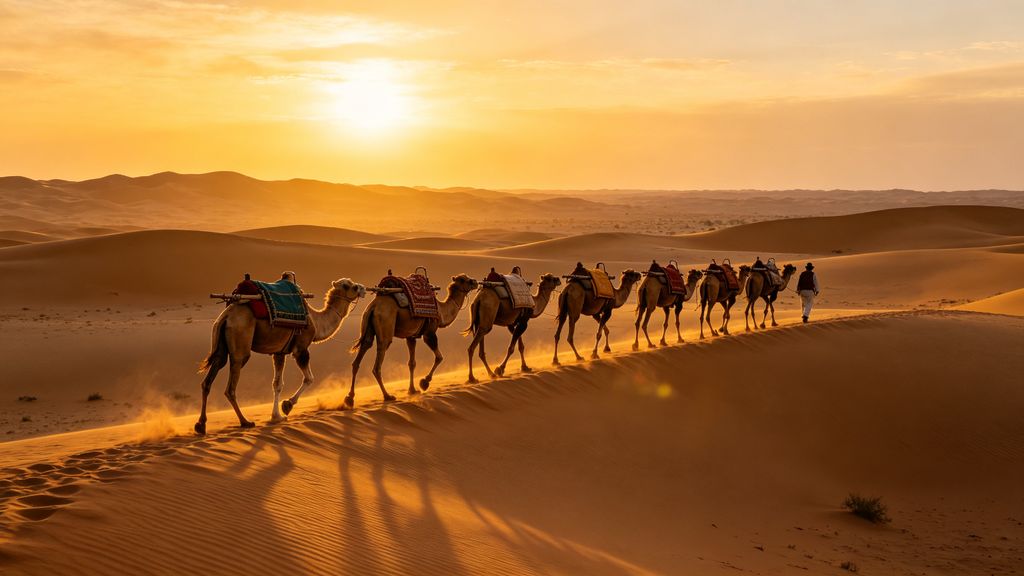
The Silk Road was a network of trade routes established during the Western Han Dynasty (202 BC - 8 AD), starting from Chang'an (today's Xi'an), through Gansu and Xinjiang, to Central Asia, West Asia, and the Mediterranean. It got its name because Chinese silk was the main commodity traded along this route.
The basic route of the Silk Road took shape in the Han dynasty. Starting from Chang'an, it went through the Hexi Corridor and split into southern and northern routes: the southern route passed Yangguan, Loulan, Khotan, to Yarkand; the northern route passed Yumenguan, Jiaohe, Kucha, to Kashgar. The two routes met in Kashgar, crossed the Pamir Mountains, reached Parthia (modern Iran), and continued west to the eastern Mediterranean and Rome.
The Silk Road was not just a trade route, but a cultural exchange route. Chinese silk, porcelain, tea, papermaking, printing, gunpowder, and the compass all spread to the West along this route. Meanwhile, Western Buddhism, Islam, grapes, alfalfa, music, dance, and magic also spread to China along this route.
The Tang dynasty was the golden age of the Silk Road. Chang'an was the largest city in the world, with over a million people, tens of thousands of whom were merchants, envoys, and international students from all over the world. You could see foreigners everywhere, hear foreign music, eat foreign food—Chang'an was a truly international metropolis.
Today, China's "Belt and Road Initiative" inherits and builds on the ancient Silk Road. Two thousand years ago, camel caravans crossed the desert; today, China-Europe freight trains connect China and Europe at high speed. The spirit of the Silk Road—peaceful cooperation, openness and inclusiveness, mutual learning, and mutual benefit—continues to this day.
The Silk Road is one of the greatest trade routes in human history. Over two thousand years ago it linked China with the world.
It began with Zhang Qian "cutting open" the Western Regions in the Western Han. Thereafter camel bells rang, caravans never ceased, and trade between China, Central and West Asia and Europe continued for two millennia.
Its most famous cargo was, of course, silk - plus porcelain, tea, lacquer and iron; from the west came jade, spices, glass, grapes and alfalfa.
It changed the Chinese table: grapes, walnuts, pomegranates, carrots, cucumbers and garlic are all Silk Road "imports".
It changed world fashion: Chinese silk swept Rome; Roman nobles prided themselves on silk, some complaining "silk makes Romans extravagant".
Trade brought wealth and culture: Buddhism entered China along the road; Chinese monks travelled it to India; Western music and dance merged into Tang court music.
Cities prospered by trade: Dunhuang, Loulan, Kucha, Samarkand, Baghdad - each name a "world city" of its day.
The Tang was its golden age: in Chang An West Market, Hu merchants ran shops, Persian silver coins circulated with Tang copper - thoroughly international.
Under the Mongol empire the road flourished again; Marco Polo came to China then, and his book made Europe long for the East.
As maritime trade rose, the land route declined, but its spirit - openness, exchange, mutual benefit - never died.
In 2013 China proposed the Belt and Road Initiative; in 2014 the "Silk Roads: Chang An-Tianshan Corridor" entered world heritage.
Today China-Europe freight trains follow roughly the old route, carrying Chinese goods to Europe and European goods back - ancient camel bells replaced by train whistles.
The Silk Road shows that civilisations can coexist peacefully and prosper together. This road is humanity shared treasure.

