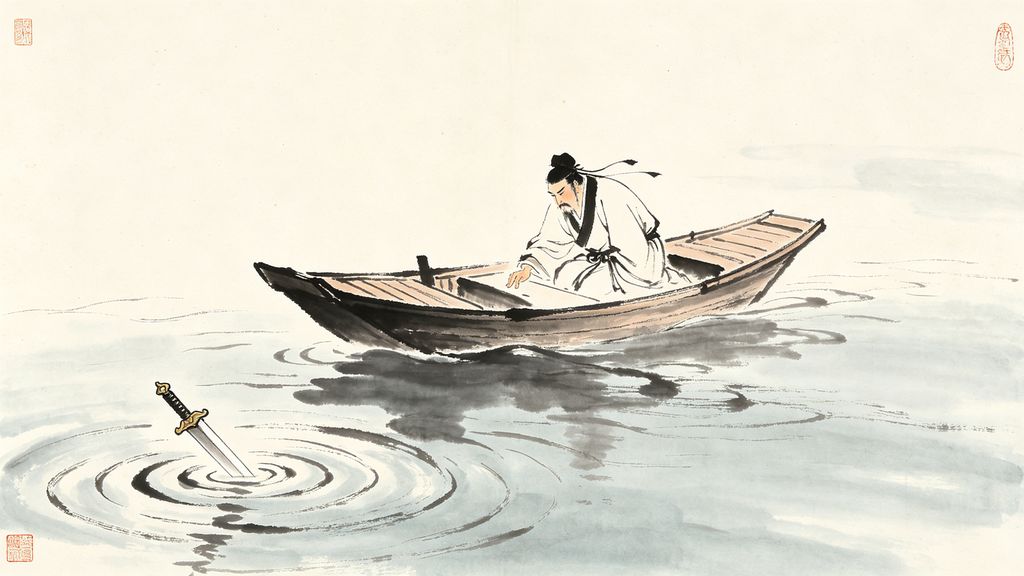
A man from the state of Chu was crossing a river by boat. Midway across, he accidentally dropped his sword into the river. He quickly cut a mark on the gunwale with his knife, saying: "This is where my sword fell."
When the boat docked, the man jumped into the water from the marked spot to find his sword. The boat had traveled far, but the sword was still where it fell. Isn't that a foolish way to find a sword?
Of course he couldn't find it this way. The boat moved forward, but the sword didn't move with the boat. Isn't it foolish to look for a sword this way?
This story teaches us: the world is constantly changing. When you think and act, you must consider these changes and adapt to them. You cannot be rigid and refuse to adapt to new circumstances.
This is the story of "Marking the Boat to Find the Sword"—being rigid and inflexible. In today's fast-changing world, old methods quickly become outdated. We must adapt flexibly to actual situations—don't mark the boat and expect to find the sword there.
The tale: a man of Chu crossing a river; mid-river his sword fell into the water. Unhurried, he carved a notch on the gunwale: "my sword fell from here."
At the shore he jumped in, searching by the notch. But the boat had travelled far; the sword stayed in the water where it fell - naturally he found nothing.
The story comes from Lüshi Chunqiu, mocking "notch-carving sword-seekers": the world has changed, yet they still use old methods and old eyes.
"Kè zhōu qiú jiàn" means: viewing changing things with a static mind. The boat moves, the water flows, time passes - while his method stayed frozen at the moment the sword fell.
Today it reminds us to adapt and keep up: markets change, business models must; technology changes, ways of learning must; environments change, mindsets must.
It invites self-reflection: if you rely on one learning method, facing new knowledge you are carving a notch. Language learning especially - listen, speak, read widely; stay flexible.
A romantic reading: stop dwelling on "where the sword fell" and look at "where the boat is now" - the past will not return; the future lies ahead.
Remember: the boat moves, the water flows, people change - methods must advance with the situation.
It reminds us: time and place change; minds must change too. Chinese has a phrase for this: "yǔ shí jù jìn" - advancing with the times.
It also reminds learners: language is alive. Expressions from ten years ago may be dated; textbook sentences may be rare in life. Touch real Chinese often.
The best state of learning a language is like water: take the shape of any container. Flexibility lets you go far.
"Notch-carving" is close to "mò shǒu chéng guī" - clinging to old rules. But Chinese also admire "suí jī yìng biàn" - adapting flexibly. Together they form a fine antonym pair. Learning Chinese, you meet changes too: the same word means differently in different sentences; the same grammar differs by context. Learn to adapt, and your Chinese comes alive.

