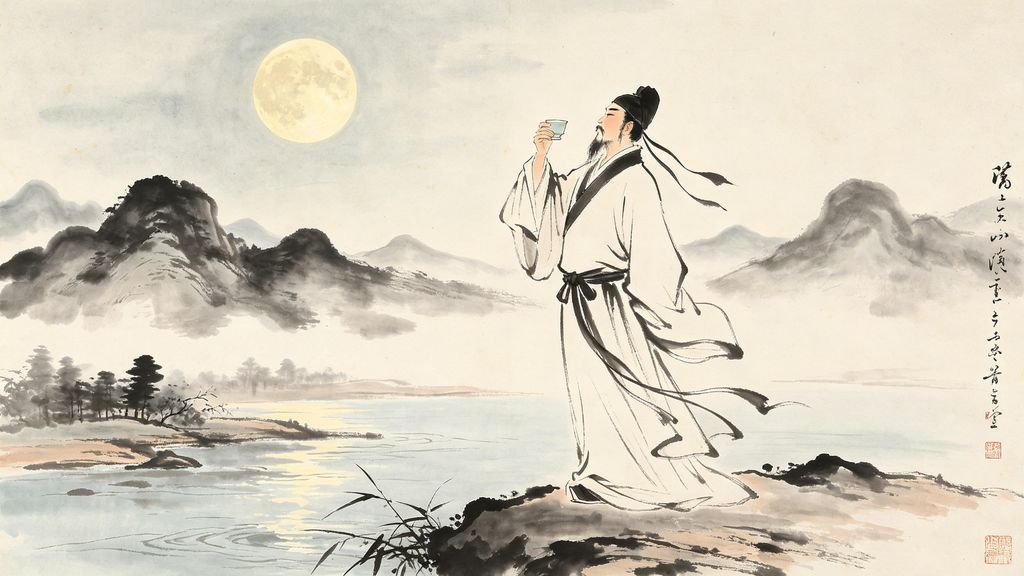
Li Bai (701-762), courtesy name Taibai, art name Qinglian Jushi, is known as the "Poet Immortal." He wrote about 1,000 poems in his lifetime, collected in "The Complete Works of Li Taibai." Almost every Chinese person can recite one or two of his poems: "Before my bed lies a pool of moonlight, I thought it was frost on the ground," or "The cataract plunges three thousand feet straight down, as if the Silver River fell from the ninth heaven."
Li Bai's poetry is known for wild imagination. Writing about Lushan waterfall, he says it plunges 3,000 feet as if the Milky Way fell from the sky. Drinking wine? He must drink 300 cups. Sorrow? White hair 30,000 feet long, because sorrow is that deep. This kind of unrestrained imagination is unique in all of Chinese poetry.
Li Bai loved wine. Du Fu wrote in "Eight Immortals of the Wine Cup": "Li Bai writes a hundred poems per dou of wine, sleeps in the tavern on Chang'an market street. The emperor calls him to come aboard, but he refuses, saying he is an immortal of wine." Many of his most famous poems were written while drunk.
Li Bai spent his whole life traveling. At 25, he left Sichuan and traveled across most of China—Sichuan, Hubei, Hunan, Jiangsu, Shandong, Shanxi, Shaanxi. His poems describe countless famous mountains and rivers: Lushan, Tiantai Mountain, Emei Mountain, Mount Tai. You could say he was China's original "travel blogger," except instead of photos, he wrote poems.
Li Bai died in Dangtu (today's Ma'anshan, Anhui). Legend says he got drunk, saw the moon reflected in the water, reached out to grab it, and drowned. Though likely not true, the story perfectly fits his personality—romantic, free, like a child. 1,300 years later, we still read his poems and envy his life.
Li Bai (701-762), courtesy name Taibai, style Qinglian Jushi, is the greatest romantic poet of the Tang dynasty, honoured as the "Poet Immortal". He left nearly a thousand poems of bold, free-flowing style and magnificent imagination - the brightest name in Chinese poetry.
Legendary life: born in Suiye (today Kyrgyzstan), he moved with his family to Jiangyou, Sichuan at five. In youth he roamed with a sword across much of China. At 42 Emperor Xuanzong summoned him to Chang an as a Hanlin academician, where he wrote the proud lines "laughing at the sky I walk out the door - how could I be a man of the grass?" But his bold nature and clashes with power sent him away within three years; he then wandered, wrote and drank until his end in Dangtu.
Masterpieces: Jing Ye Si is the first poem every Chinese learns - "bright moonlight before my bed, I suspect frost on the floor; lifting my head I watch the moon, lowering it I think of home" - twenty characters of pure homesickness. Looking at the Waterfall on Mount Lu: "it flies straight down three thousand feet, as if the Milky Way falls from the ninth heaven" - exaggeration at its most vivid. Invitation to Wine: "do you not see the Yellow River come from heaven, rushing to the sea never to return?" - sheer grandeur.
Why "Poet Immortal"? His verse brims with immortal imagination: ascending to heaven, toasting the moon, roaming with immortals. Solitude becomes romantic in "raising my cup to invite the bright moon, with my shadow making three"; defeat becomes heroic in "the day will come to ride the wind and waves, hoisting my sail straight across the sea".
His friendship with Du Fu is the great romance of Chinese letters: eleven years apart, they met as kindred spirits, travelled, drank and exchanged poems. "The works of Li and Du stand; their light shines ten thousand zhang" - the two giants illuminating the same age.
Places: Jiangyou, Sichuan (hometown memorial and Taibai Tower), Dangtu, Anhui (his tomb), Mount Lu, Jiangxi, and Caishi Rock in Ma anshan (legendary site of his drunken moon-chase). Reading Li Bai then walking his roads is the most romantic journey.

