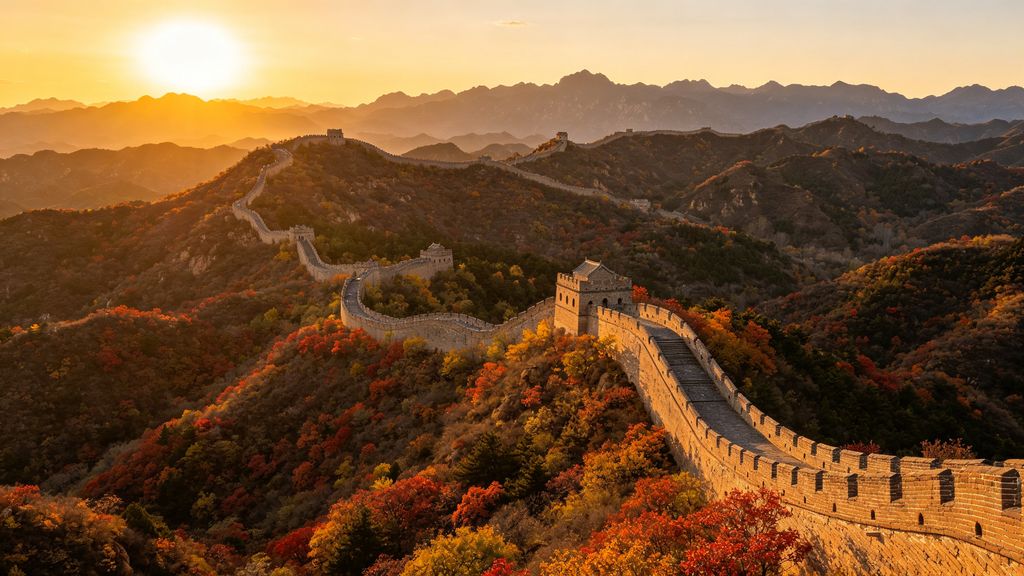
The Great Wall is China's most famous landmark and the longest man-made structure on Earth. It stretches from Shanhaiguan in the east to Jiayuguan in the west, winding over 21,000 kilometers. But many people don't know that the Great Wall is not one continuous wall—it's many sections built by different dynasties, connected together.
Many people say "the Great Wall is the only man-made structure visible from space." This is actually a myth. Astronauts have confirmed that you cannot see the Great Wall from low Earth orbit with the naked eye. If you could see the Great Wall, you should be able to see all highways and airport runways too. This myth started in the 19th century among Westerners and grew over time.
The Great Wall was first built during the Spring and Autumn and Warring States periods (7th-4th century BC). Different states built walls to defend against each other. After Qin Shihuang unified China, he connected the northern walls into the "Ten Thousand Li Long Wall." Later dynasties like Han and Ming also repaired and expanded it. The wall we see today was mostly built in the Ming dynasty.
Many people died building the Great Wall. It is estimated that during the Ming dynasty, 2-3 people died for every meter of wall built. That's why the Great Wall is also called "the longest cemetery on Earth." The legend of Meng Jiangnu crying down the wall, though a myth, reflects the suffering of ordinary people.
Today, the Great Wall is China's most popular tourist attraction. If it's your first time, go to Badaling or Mutianyu. Badaling is the most famous but crowded; Mutianyu is less crowded with better scenery. Best time to visit is autumn, when the mountains turn red and the wall winds through the leaves—that's when it looks its best.
"Can the Great Wall be seen from space?" is one of the most asked questions about China. The answer: hardly. But the question itself made the Wall even more famous.
Why so hard? The Wall is long but narrow - averaging six to eight metres wide, like an ordinary road; from hundreds of kilometres up, it is nearly invisible.
The claim traces to a 1932 London Times article saying the Wall was "the only human structure visible from the moon". Widely repeated, it was a misunderstanding.
In 2003 Chinese astronaut Yang Liwei flew Shenzhou-5. He said the Wall was not visible to the naked eye from space - supported by science.
Analysis: the naked eye resolution limit from orbit is roughly ten to twenty kilometres across; the Wall is only metres wide, far below the limit.
Under special conditions it is not impossible: in low orbit, with right sunlight and clear air, telephoto lenses or specialised equipment can catch it.
In 2004 ESA satellite images did capture the Wall - but from low orbit with high-resolution equipment.
Why do people want it visible? Because it is so great: over 21,000 km long, the longest structure humans have built on Earth.
The question also makes us think: how should we measure the "greatness" of human works - by size, or by the history and wisdom they carry?
The Wall carries endless stories: war and peace, rise and fall of dynasties, countless toil and dreams.
Even if invisible, it remains a universally recognised symbol of China. Astronauts rather say: from space you can see China wonders, not least the Wall.
Actually more visible from space are China marvels: the Tibetan Plateau, the Yangtze and Yellow rivers, and glittering cities.
Next time someone asks, you can say: almost invisible to the naked eye - but it forever exists in Chinese hearts.

