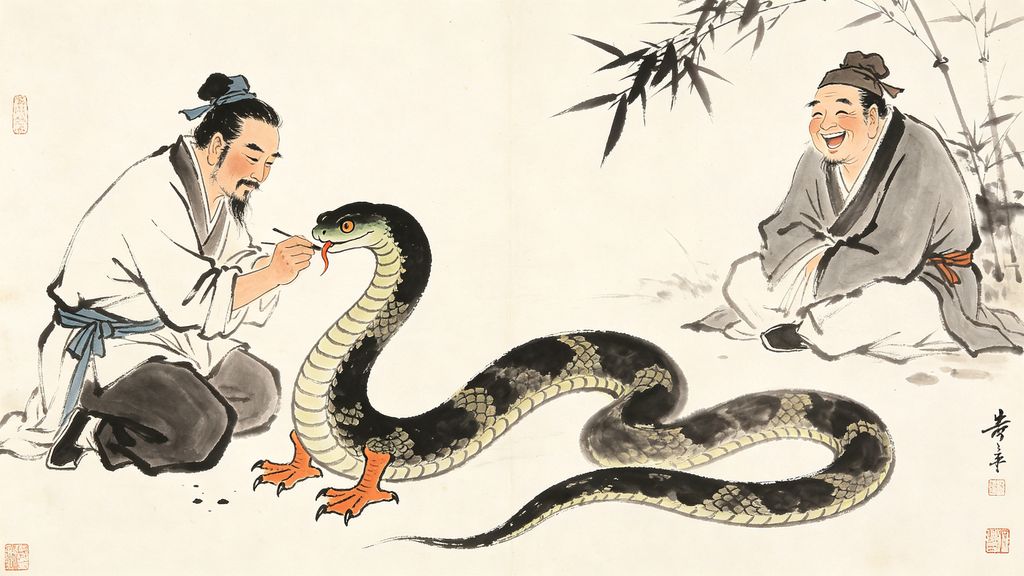
During the Warring States period, a nobleman in the state of Chu rewarded his servants with a pot of wine after a sacrifice. There was too little wine for everyone to share, but enough for one person. So they agreed: race to draw a snake on the ground, and whoever finished first got the wine.
One man finished drawing the snake first. He picked up the wine pot, ready to drink, and seeing that the others were still drawing, he proudly held the pot in his left hand and started drawing legs on the snake with his right. "You're so slow," he thought. "I can even add legs to my snake!"
Before he finished drawing the legs, another man completed his snake. He grabbed the wine pot and said: "Snakes don't have legs. How can you draw legs on a snake?" Then he drank the wine. The man who had added the snake legs ended up losing the prize.
This is the origin of the idiom "Drawing Legs on a Snake" (hua she tian zu). Snakes naturally have no legs—if you insist on adding them, it's not just extra, it turns the snake into something else entirely. The idiom means doing something unnecessary that not only adds no value, but actually ruins the result.
In daily life, we see "drawing legs on a snake" everywhere: writing a report that's already clear, then piling on empty phrases; making a clean PPT, then adding flashy animations; giving advice that hits the point, then rambling on about unrelated things. Remember: do what needs to be done, and don't add legs to the snake.
"Huà shé tiān zú" is one of China most famous idioms. The tale: in the Warring States, a man of Chu rewarded his retainers with wine; too few wine, too many people, so they raced drawing snakes - first to finish drinks.
One man finished first, and seeing others still drawing, wanted to show off: "I can add feet to the snake." So he drew feet.
While he drew, another finished his snake, snatched the pot: "Snakes have no feet. With feet, it is not a snake. I was the first to finish." He drank.
The feet-adder lost the wine already his because of superfluous steps. The story comes from Zhanguo Ce, told for over two thousand years; nearly every Chinese person knows it.
Why does overdoing spoil things? Because it breaks the nature of the thing. Snakes have no feet; add them and it becomes neither snake nor beast - the extra part is the flaw.
Today it reminds us: know when to stop. An essay stops where it should; one more paragraph becomes rambling. A dish leaves the pan at the right moment; one more minute changes the taste.
It also warns against complicating simple matters. Solve problems at the key point; no need to cover everything and pile on layers.
For learners, the memorable image is "snakes have no feet". Remember that, and you always know when to stop.
Actually there is a gentle reading: it reminds us to respect the nature of things. A snake is a snake; matters need no extra decoration.
Chinese value "just right" in everything - tea too hot tastes bitter, too cool loses aroma; speech too much annoys, too little confuses.
Learning Chinese, you will find one meaning can be said in one clear sentence or lost in ten vague ones. Learning this idiom means learning subtraction in expression.

