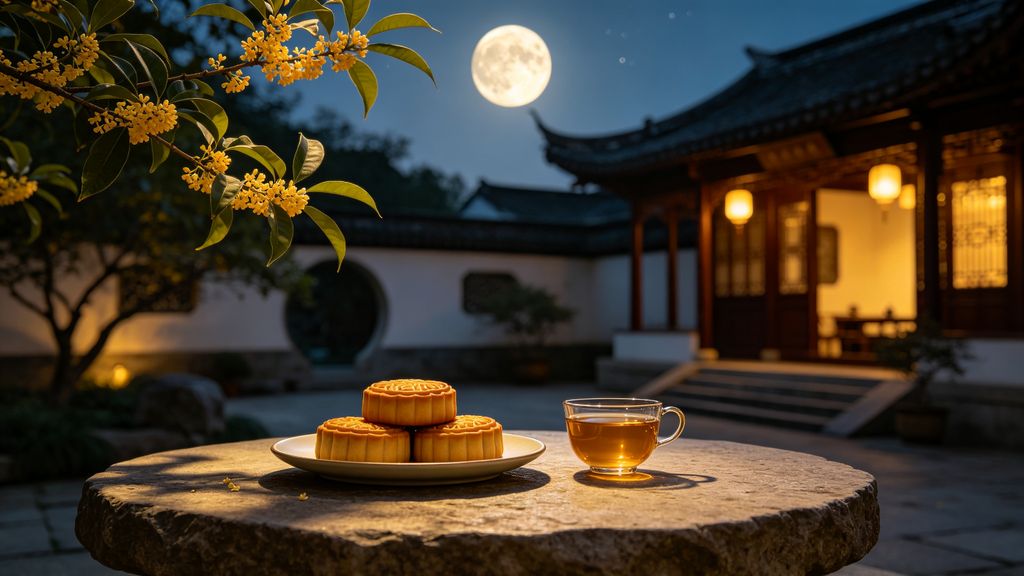
The Mid-Autumn Festival falls on the 15th day of the 8th lunar month. The moon is roundest and brightest that night. No matter how far away they are, Chinese people try to return home for a reunion dinner.
Mooncakes are always on the table. They are round like the full moon, symbolizing family togetherness. Take a bite and you find lotus seed paste, red bean, or egg yolk inside — sweet and rich.
Legend says mooncakes began in the Yuan dynasty. Han Chinese rebels hid messages inside mooncakes to coordinate an uprising. Eating mooncakes at Mid-Autumn became tradition ever since.
Today mooncakes come in endless flavors: from classic lotus paste with egg yolk to trendy ice cream and chocolate. But no matter how they change, the meaning of family gathering under the full moon stays the same.
Mid-Autumn Festival is a traditional Chinese holiday on the 15th day of the 8th lunar month. That night the moon is roundest and brightest; Chinese admire the moon, eat mooncakes and reunite with family.
Why are mooncakes round? Because roundness means reunion. Chinese believe that on this night, a family sitting together eating round mooncakes, like the round moon, stays forever united.
A famous legend: at the end of the Yuan dynasty, people wanted to rebel against Mongol rule but could hardly pass messages. Someone hid notes with uprising plans inside mooncakes and distributed them. On the 15th, people found the notes and rose up successfully.
The legend is only a story, but it shows mooncakes long ago were not mere food - they once carried an important mission.
Mooncake types abound: Cantonese style has thin crust and rich filling, most commonly lotus-paste egg yolk; Suzhou style is layered and crumbly; there are also snow-skin and five-nut mooncakes.
Other customs: moon-gazing, lantern riddles, river lanterns. Children walking the streets with rabbit lanterns are many Chinese childhood memories.
Auspicious greetings: "huā hǎo yuè yuán" (flowers fine, moon full) and "hé jiā tuán yuán" (whole family reunited). If you celebrate it in China, taste a mooncake and say "Zhōngqiūjié kuàilè!" (Happy Mid-Autumn Festival!)
The moon in Chinese culture means longing. The most famous poem is Su Shi line: "may we live long and share the moon a thousand miles apart."
Mid-Autumn Festival is China deepest attachment to reunion.
Mooncakes have etiquette: usually cut into small pieces and shared by the family, symbolising shared reunion. On Mid-Autumn day, wherever you are, look up at the moon - it is the "same lamp" Chinese people light for family and friends all over the world.
The Mid-Autumn moon is also the most romantic Chinese "messenger". Without phones or video, the ancients sent longing through the moon. Today, even with the internet, Chinese seeing the full moon still feel a gentle "homesick". If you send a Chinese friend "中秋快乐" (happy Mid-Autumn), they will find you very thoughtful - because you understand one of their most important festivals.

