In spring 1974, several farmers near Xi'an were digging a well during a drought. They hit something hard — a clay head. They picked up the fragments, not knowing they would stun the world.
These figures belonged to China's first emperor, Qin Shi Huang. After unifying the six warring states, he worried about having no army to protect him in the afterlife, so he ordered thousands of life-sized clay soldiers to be built and stationed beside his tomb.
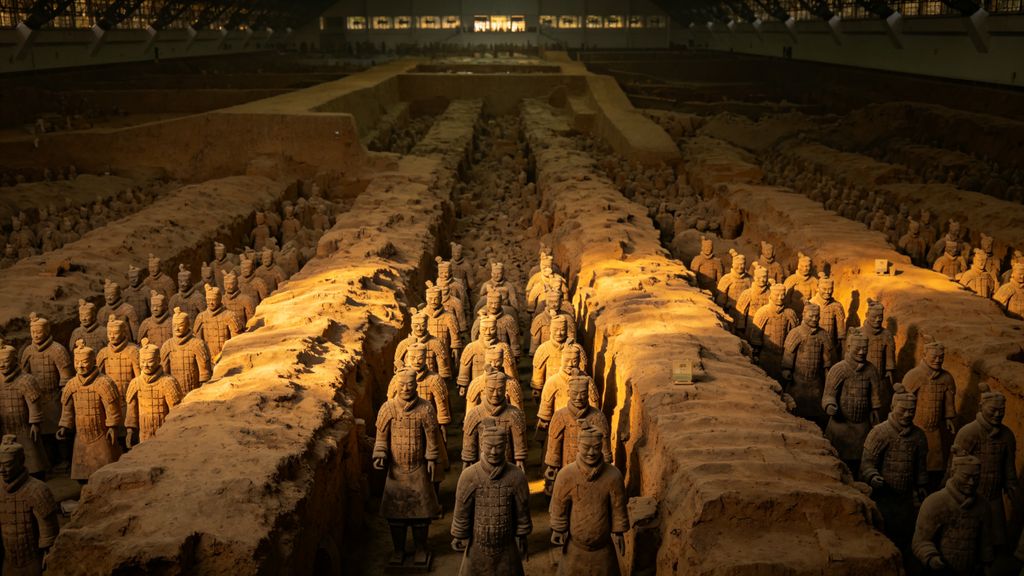
Every soldier has a different face: some have beards, some smile gently, some look stern. They wear different armor and once held real weapons. This silent army stood underground for over two thousand years.
Today the museum welcomes millions of visitors a year. Standing at the edge of the pit and looking down, thousands of soldiers line up in formation, like an army awaiting orders. It is China's most breathtaking historical landmark.
The Terracotta Army, formally the Terracotta Army of Qin Shi Huang, is the burial goods of the first emperor mausoleum in Lintong district, Xi An, Shaanxi - hailed as the eighth wonder of the world.
In March 1974, farmers of Xiyang village, Lintong county, digging a well, found pottery fragments. The news reached Beijing; archaeologists rushed over, and a world-changing excavation began.
Survey revealed three pits in a "pin" (goods) shape, over twenty thousand square metres - equivalent to more than fifty basketball courts.
Pit No.1 is the main force: over six thousand warriors in neat ranks, magnificent; Pit No.2 a mixed force of archers, infantry, cavalry and chariots; Pit No.3 the "headquarters" with only a few dozen officer figures.
The height amazes: warriors average 1.78 metres, the tallest 1.96 - as tall as real people, extremely rare in ancient pottery.
The process: craftsmen moulded rough bodies and heads, sculpted facial features by hand, assembled, then fired in kilns.
The fired figures were painted: skin tones on faces and hands, brown armour, red, green and purple collars. Colours at excavation were strikingly bright.
Each figure is a unique piece: over ten thousand faces, no two alike. Researchers believe real soldiers were likely the models.
The pits hold over 130 chariots, 600 pottery horses and over 10,000 weapons. Bronze swords remain sharp; arrowheads were precision-machined with minimal error.
Their master, Qin Shi Huang, was China first emperor, who unified script and measures, built the Great Wall, and left this colossal tomb.
Scientists probing the mausoleum with modern technology find the underground palace intact, with rivers and seas simulated in mercury. For technical reasons it remains unopened.
In 1998 then-US president Clinton visited and called it "magnificent". Britain queen, French and German leaders - world leaders all have come.
The museum welcomes tens of thousands daily. Standing before the pits, you feel: two thousand years ago, Chinese hands already wrote an epic in clay that shakes the world.

