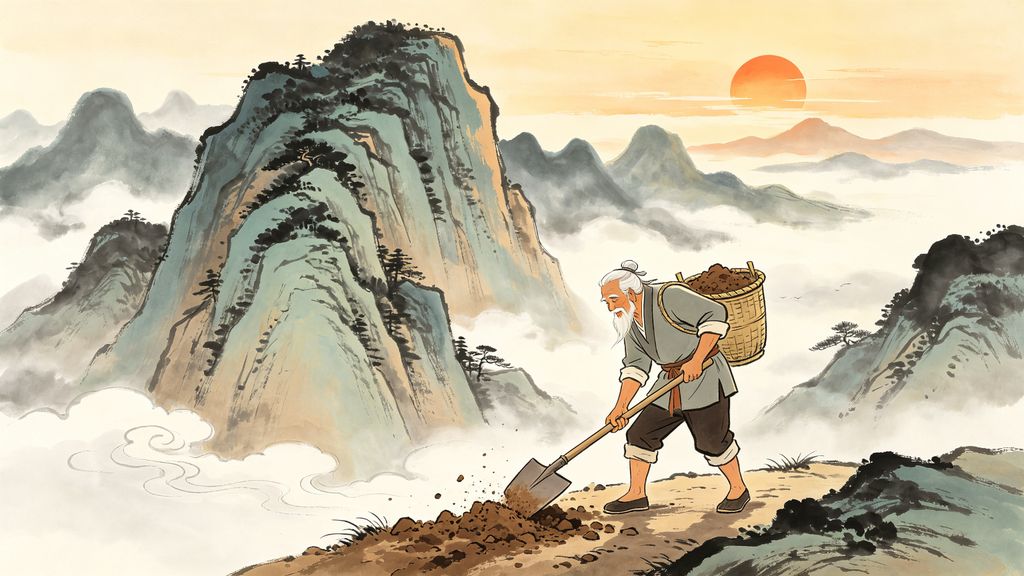
Long ago there lived an old man of ninety whose home was blocked by two huge mountains, forcing his family to walk a very long way around. He made up his mind: he would move both mountains away!
His neighbor laughed at him: "At your age you cannot even pull up a tree — how could you possibly move a mountain?" The old man replied: "If I cannot finish it, my sons will; if my sons cannot, my grandsons will. My descendants will never run out, but the mountains will never grow taller. So why can't it be done?"
His persistence moved the Emperor of Heaven, who sent two immortals to carry the mountains away on their backs. From then on, the road in front of his home became flat and wide.
Today the idiom "The Old Man Who Moved Mountains" describes someone with strong willpower who fears no difficulty and never gives up. Real strength is often not dramatic — it comes from countless small acts of persistence.
Legend says in ancient times an old man named Yugong, nearly ninety, lived with two great mountains before his house - Taihang and Wangwu - making going out very inconvenient.
Yugong gathered his family: "let us move these two mountains together!" His family thought him mad, but he was determined. They began digging daily, hauling earth to the sea.
A smart old man named Zhisou mocked him: "You are nearly ninety and cannot pull up a tree; you want to move two mountains? You are a fool!" Yugong said: "If I cannot finish, my sons will; if sons cannot, grandsons will; generations without end, while the mountains will never grow taller!"
His words moved the Heavenly Emperor, who sent two immortals to carry the mountains away. From then on, Yugong door was level. The story comes from Liezi Tang Wen, one of China most famous fables.
"Yúgōng yí shān" means: with firm belief, even the hardest task can be done. It praises persistence, willpower and generational striving.
Today it describes people who defy difficulty and persist long-term. Many great Chinese projects - the Red Flag Canal, the Three Gorges Dam - are called "Yugong moves mountains" projects.
For learners it is inspiring: language learning is like moving a mountain - a few words a day becomes thousands a year. As long as you do not stop, the mountain will eventually move.
Remember his words: the mountain will not grow, but you keep improving. Persistence is the greatest wisdom.
In China the idiom has a famous modern version: people of Lin County, Henan, spent ten years chiselling a "artificial heavenly river" - the Red Flag Canal - on Taihang Mountain. People call it a modern Yugong tale.
It also reminds us: facing big goals, do not fear; break them into daily tasks and move closer each day. That is the wisdom of accumulating little by little.
As a Chinese learner, be a "Yugong": three characters today, five words tomorrow, hundreds in a year. The mountain is not high; stopping is what you must fear.
From individuals to the nation, "Yugong moves mountains" is a spiritual symbol in China. The proverb says "with enough effort, an iron pestle grinds into a needle" - the same truth: real power comes from daily persistence. Today many Chinese companies require "Yugong spirit" of themselves: no haste, step by step to completion. As a learner, if your goal seems far, think of Yugong: he began "moving mountains" at ninety. Whenever you start learning, it is not late.

