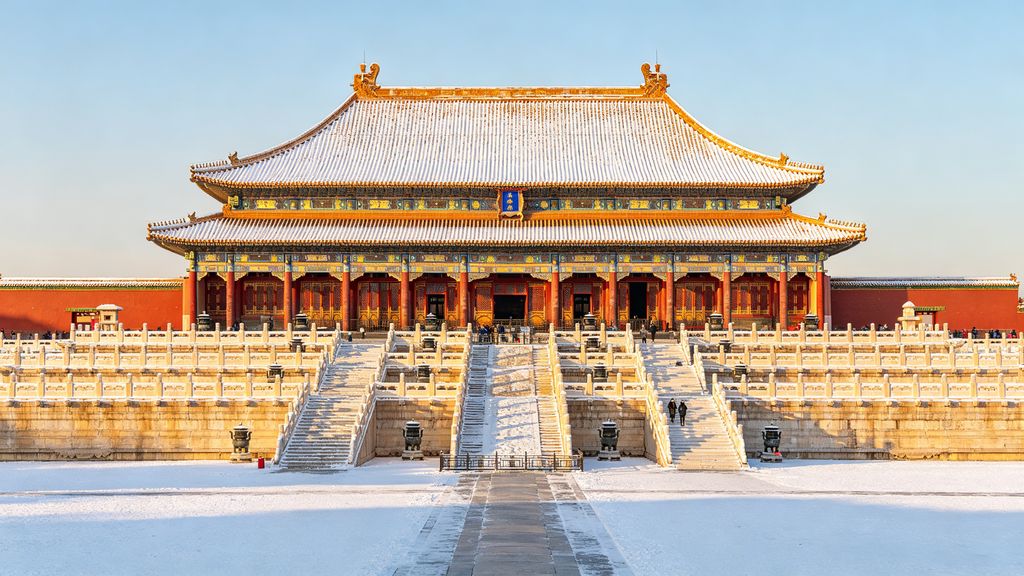
Beijing's Forbidden City (the Palace Museum) was built in 1420, with over 600 years of history. It was home to 24 emperors of the Ming and Qing dynasties, with 9,999.5 rooms across 720,000 square meters — the largest palace complex in the world.
Why "Forbidden" and "Purple"? Ancient people believed the Jade Emperor lived at the Purple Star (the North Star), and the emperor was the "Son of Heaven", hence "purple"; ordinary people were barred, hence "forbidden".
Today it is a museum receiving millions of visitors a year, holding over 1.8 million artifacts from porcelain and paintings to clocks. Golden ginkgo in autumn, snowy scenes in winter — it is beautiful all year round. Book tickets online in advance.
The Forbidden City (Gugong), also called Zijincheng, sits at the centre of Beijing central axis. Home to 24 Ming and Qing emperors, construction began in 1406 (4th year of Yongle) and finished in 1420 - over 600 years old and the largest, best-preserved timber palace complex in the world.
Key figures: about 720,000 sq m of land and 150,000 sq m of buildings, with 70-plus palaces and over 9,000 rooms. It is surrounded by walls and a moat, with corner towers. The central axis runs from Meridian Gate through the Halls of Supreme Harmony, Central Harmony and Preserving Harmony, the Palace of Heavenly Purity, to the Gate of Divine Might.
Why "Purple Forbidden City": ancient astronomers divided the sky into three enclosures; the Purple Microcosm at the centre was where the Heavenly Emperor lived. The emperor palace was the "Purple Palace", and because it was forbidden to commoners, it became the Forbidden City.
The three main halls are the core: the Hall of Supreme Harmony (grand ceremonies - enthronement, imperial weddings), Central Harmony (emperor rest and receiving officials), and Preserving Harmony (palace examinations, banquets). White marble terraces, bronze cranes and turtles project imperial majesty.
Practical info: peak-season ticket RMB 60, low season 40; open 8:30-17:00 (closed Mondays); real-name booking required at least one day ahead via the official site or mini-programme. Recommended route: enter at Meridian Gate, see the three halls, the Palace of Heavenly Purity, the Imperial Garden, exit at Divine Might Gate.
Tips: the palace is huge - one visit cannot cover it. First time, focus on the central axis plus the Treasure Gallery and Clock Gallery; rent a hanfu for photos against red walls and golden tiles; for depth, watch the documentary "The Forbidden City" or book a guide.
A "do not miss" list for the Forbidden City: ① the corner towers - at dusk, reflections across the moat are a classic photography spot; ② Jingshan Park outside the Divine Might Gate - climb to Wanchun Pavilion for the best aerial view of the whole palace; ③ the Treasure Gallery - imperial gold, jade and clocks, flashier than the main halls. All are near or inside the palace, yet many visitors skip them.
A question to ponder: why is the Forbidden City more than a symbol of power? Its building hierarchy (roof styles, door-nail counts, step numbers), colour rules (yellow tiles and red walls reserved for royalty) are a "visible order". Reading the architectural language of the palace is reading how ancient Chinese society used space to maintain ritual order.
A mnemonic for visiting the Forbidden City: book ahead, do not come on Monday, choose a morning ticket, do not skip a guide, central axis plus Treasure Gallery, one full day is just right. Follow it and your visit will be relaxed. With kids, rent a children audio guide; the Palace Museum shop "palace cat" blind boxes are a favourite.

