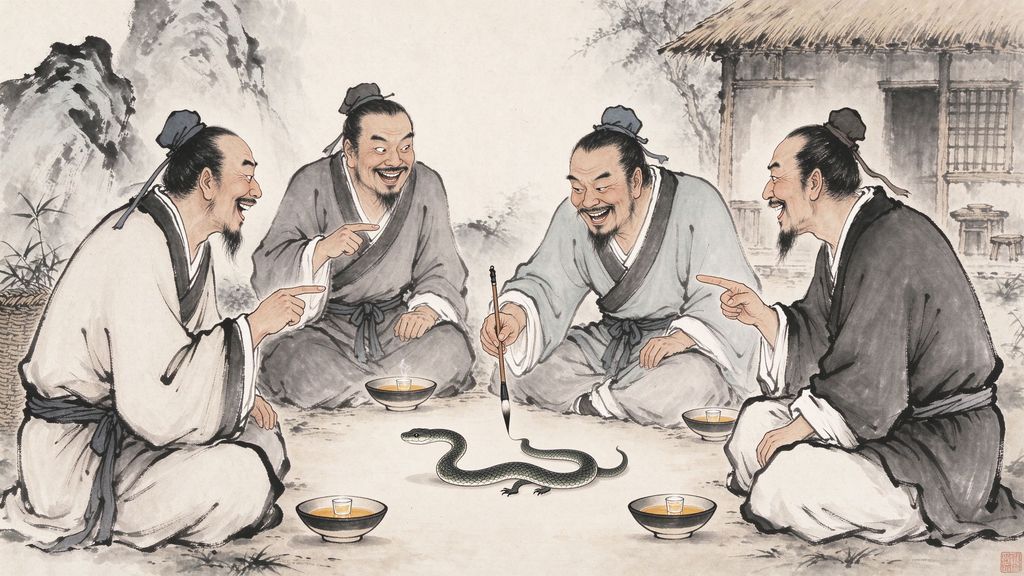
The story: in ancient Chu, people held a snake-drawing contest; whoever finished first won the wine. One man finished, saw others still drawing, and proudly added feet to his snake. Another finished right then: "Snakes have no feet; with feet it is not a snake." So the wine went to the other.
Moral: overdoing things ruins them; "drawing a snake and adding feet" means doing something unnecessary and making it worse.
Example: the report is clear already; piling on more charts would be adding feet to a snake.
Similar idioms: doing something superfluous, counterproductive, outsmarting yourself.
In English: to gild the lily. East and West both warn against excess - "less is more".
Background: from the Strategies of the Warring States, a gem of the ancient art of persuasion.
"Huà shé tiān zú" is the classic representative of "doing more than needed" among Chinese idioms. The tale happens in Warring States Chu.
A group of retainers raced drawing snakes; first finisher drinks. One finished first, but in triumph added feet to the snake.
While he drew, another finished, snatched the pot: "Snakes have no feet; with feet it is not a snake. I finished first; the wine is mine."
The feet-adder lost the wine already in hand. The story teaches: superfluous action often spoils the result.
Today it reminds us: know when to stop; do not add feet to snakes.
At work, a mature plan needs no extra "highlights"; in writing, once said clearly, no piling; in life, do not complicate simple things.
For learners it is a mirror: in speaking and writing, first learn "just right".
Remember: snakes need no feet, matters need no extras - knowing when to stop is the greatest cleverness.
Its synonym is "nòng qiǎo chéng zhuō" - trying to be clever but spoiling things. That is the core lesson.
Chinese life wisdom admires "less is more": not too many dishes, not too-full words, not too-absolute actions. Leave room; it is better.
Learning Chinese: master basics first, then seek elegance. Without a solid base, elegance becomes added feet.
In writing classes today it is quoted again and again: good essays stop when they should. Many students, story finished, force on an extra "reflection", spoiling the whole. Remember: "yán yǒu jìn ér yì wú qióng" - words end, meaning is endless. The highest expression is saying just enough. After writing a paragraph, ask: can I delete one more character? When you learn restraint, your expression gains power.
Chinese painting has the beauty of "blank space"; writing has the power of "restraint". These four characters teach you to find that beauty and power in expression.
One-sentence summary: less is more, stopping is advancing. Learn the opposite of adding feet, and you master expressive wisdom.
May you learn "just right", so every expression lands perfectly.

