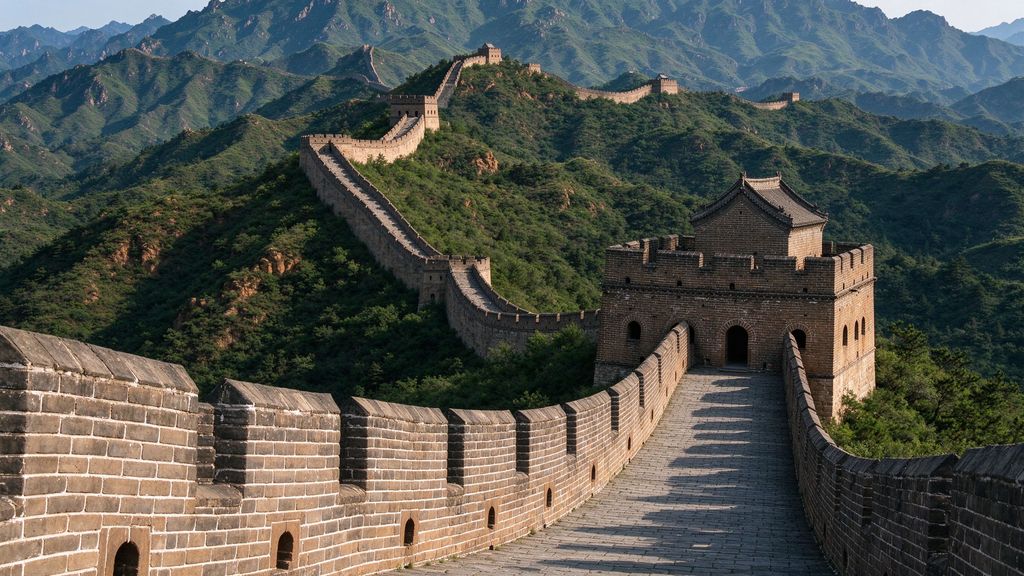
The Wall runs from Shanhaiguan to Jiayuguan, over 20,000 km total across dynasties, a UNESCO World Heritage site.
History: states built sections during the Spring-Autumn and Warring States eras; Qin Shi Huang linked them; the Ming rebuilt most of the brick Wall we see.
Function: defence against northern nomads, beacon signals, protecting trade routes; "You are not a true man until you have climbed the Wall" is a popular saying.
Best sections: Badaling (most famous, full facilities), Mutianyu (beautiful, fewer crowds), Juyongguan (the "number one pass"), Simatai (steep, night tours).
Practical: Badaling ticket RMB 40 plus cable car; easy day trip from Beijing; go early on holidays to avoid crowds.
Did you know: the Wall is not one wall but a system of walls, passes, beacon towers and forts.
The Great Wall is the longest structure on Earth. From Shanhai Pass in the east to Jiayu Pass in the west, it stretches over twenty-one thousand kilometres - hence "ten-thousand-li wall".
Its history is older than many imagine. As early as the seventh century BC, states built walls; after unifying China, Qin Shi Huang linked the walls into the first "ten-thousand-li wall".
The Wall we see today is mostly Ming-dynasty brick and stone, extremely solid. The Ming Wall ran from the Yalu River to Jiayu Pass, built over two centuries.
Each brick was exacting: about 40 cm long, 20 cm wide, 10 cm thick, weighing some 15 kg, often stamped with origin and craftsman name for quality tracing.
The scale staggers: a rough calculation says the Wall bricks could circle the Earth several times in a two-metre-high wall.
The Wall is not a simple barrier but a complete defence system: walls, passes, beacons, watchtowers and garrisons forming a three-dimensional line.
Famous passes: Shanhai Pass "first pass under heaven", Jiayu Pass "first majestic pass", plus Juyong Pass, Yanmen Pass - the great "gates" of the Wall.
The Wall witnessed endless history: Han campaigns against the Xiongnu, Tang management of the Western Regions, Ming defence of the capital. For two millennia it guarded dynasties through countless battles.
Its building carried heavy cost. Legend says Meng Jiangnu, whose husband was conscripted to build the Wall, wept it down - a tale two thousand years old that recalls the sorrow behind the stones.
In 1987 it was inscribed as world heritage - among China first, and a representative "Chinese business card".
After visiting, former US president Nixon said: "Only a great people could build such a great wall." The line is often quoted since.
Today it is a top attraction: Badaling and Mutianyu near Beijing throng with visitors. Climb the Wall and be a hero - every visitor wish.
"He who has not reached the Great Wall is no true man" - Mao Zedong phrase made the Wall a symbol of courage and persistence. Ten thousand li of brick, an epic written by Chinese hands.

