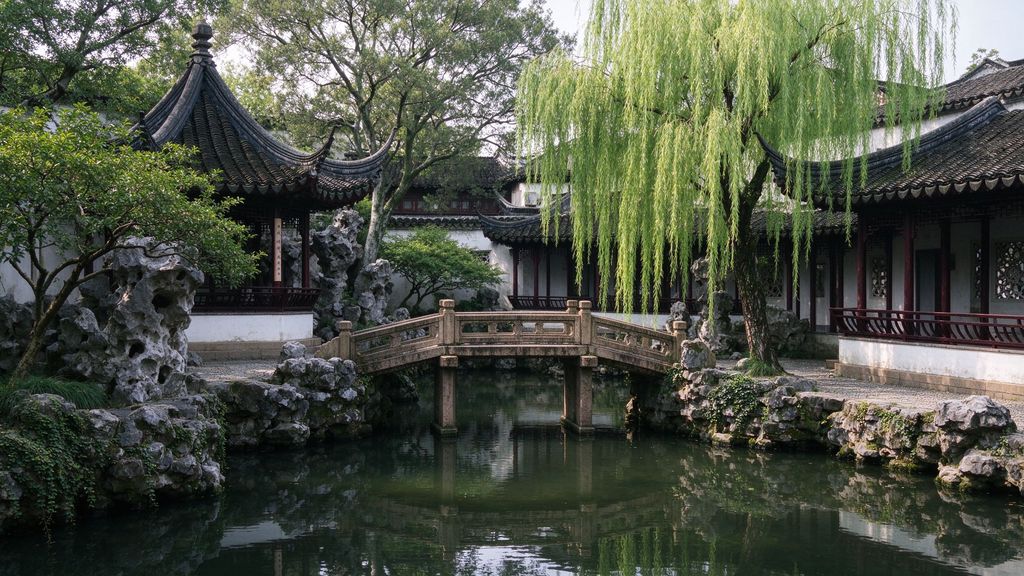
Chinese gardens, epitomised by Suzhou - Zhuozheng, Liuyuan and Wangshi - are all UNESCO World Heritage.
Three elements: rockery (jiǎshān), water (lǐshuǐ) and pavilions, aiming at "made by man, appearing nature-made".
Borrowed views: framing towers or hills beyond the wall to expand space; Liuyuan Guanyun Peak and Zhuozheng Yuanxiang Hall are classics.
Seasons: spring flowers, summer lotus, autumn osmanthus, winter snow - every step is a scene.
Meaning: gardens express the scholar-official ideal of retreat; names carry poetry (Zhuozheng = "clumsy politics" self-mockery).
Visiting: Suzhou gardens are compact - hire a guide or audio tour; 1.5-2 hours each is enough.
Chinese gardens are wonders of world architecture. Unlike the formal symmetry of European gardens, Chinese gardens seek "natural artistry" - arranging hills, water, flowers, pavilions and bridges like a painting.
Suzhou gardens are the most famous representatives: the Humble Administrator Garden, the Lingering Garden, Lion Grove. In 1997 they were listed as World Heritage. Visitors say: stepping into a Suzhou garden is stepping into an ink-wash painting.
Chinese gardens use "borrowed scenery": from a pavilion you see a distant pagoda; through one window, bamboos on the other side. Designers use doors, windows and walls to borrow distant views, making space seem endless.
Most special are "rockeries": designers stack Taihu stones into mountain shapes - low but winding, walkable, crawlable, climbable, fun like real mountains. The Lion Grove rock maze is children favourite.
Water is the garden soul. Nearly every Suzhou garden has a pond with red carp, bordered by covered corridors; sitting under the corridor listening to rain on lotus leaves is one of Chinese most romantic pleasures.
The garden philosophy is "harmony of heaven and human" - humans and nature are not opposed but in harmony. A garden is a small universe: hills, water, flowers, the turning seasons; one dwells within, content.
Visit Suzhou when you come to China. Remember: "yuánlín" garden, "jiǎshān" rockery, "huíláng" corridor, "jièjǐng" borrowed view. Walking in a garden, you understand the "poetry and distance" in Chinese hearts.
Chinese gardens are the best proof that Chinese people turned life itself into art.
Garden beauty also lies in "four different seasons": spring flowers, summer rain, autumn osmanthus, winter snow. The same garden shows entirely different scenes across the year. Many Chinese say: the most beautiful garden is not the one in photos but the one you stroll through slowly and savour carefully.
A tip for Suzhou gardens: avoid holidays; choose a weekday morning. With few visitors, you hear birds and wind and see sunlight through lattice windows on stone paths. Bring a small book and sit half an hour in a pavilion - you will understand why ancients said "stealing half a day of leisure from the busy life". This "leisure" is among the highest Chinese life pursuits.
Garden beauty lies in hills and water, and more in the heart. May you find your own peace in Chinese gardens.

