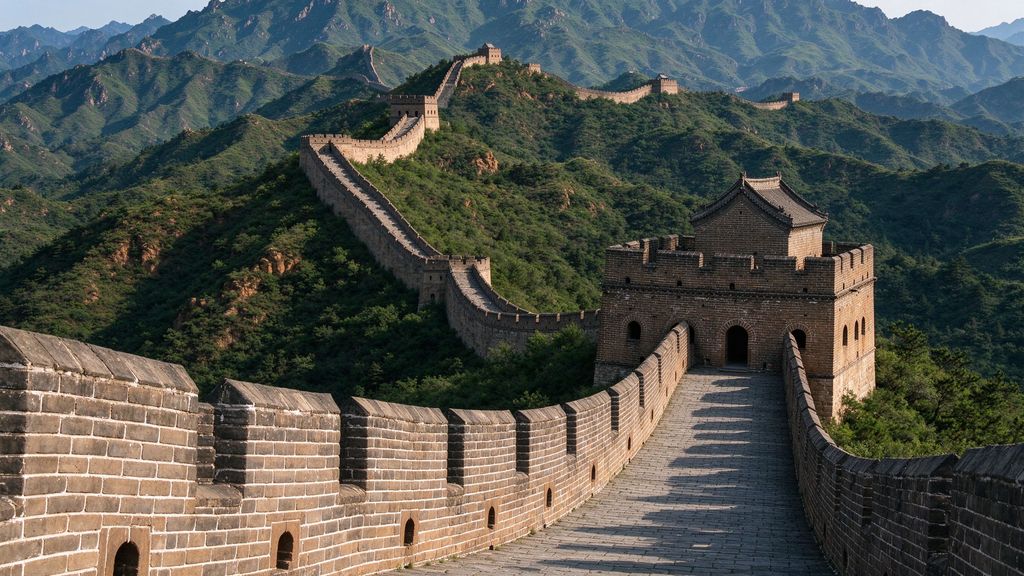
The Great Wall is not one wall but a vast defensive system of walls, passes, beacon towers and forts, stretching over 20,000 km in total. A UNESCO site since 1987.
Origins: the earliest walls date to the Warring States border defences; after unifying China, Qin Shi Huang linked and extended the northern line. Later Han, Northern Dynasties, Sui, Jin and Ming dynasties all kept building.
Most of what stands today is Ming: from Tiger Mountain in Liaoning to Jiayuguan in Gansu, reinforced with brick and stone, guarded by nine frontier towns.
Beacon signals: when the enemy came, towers lit wolf-smoke, passing the alarm tower by tower across a thousand li - the ancient "wireless".
Famous passes: Shanhaiguan (First Pass Under Heaven), Juyongguan, Jiayuguan (First Pass Under Heaven West). "He who has not reached the Great Wall is not a true man" - that is Badaling.
Today: the busiest sections are Badaling and Mutianyu near Beijing; quieter ones include Jinshanling and Simatai. Unrestored "wild wall" sections are dangerous - do not climb.
The Great Wall is the greatest defence work of ancient China and a world heritage site, spanning fifteen provinces and regions, over 21,000 km.
It began in the Spring and Autumn and Warring States periods, when states built walls against each other; in 221 BC Qin Shi Huang linked them - the first "ten-thousand-li wall".
The Han wall reached farthest west, into Xinjiang; the Ming rebuilt in brick and stone - what we see today - over two centuries.
Its body is a wall about 8 m high and 6 m wide, allowing five horses abreast; watchtowers stand at intervals for garrison and lookout.
The bricks are countless: roughly 30 million cubic metres for the Ming wall - enough, some calculate, for a wall two metres high and one wide circling the equator several times.
About ten passes dot the line, most famous Shanhai and Jiayu passes - open for trade in peace, closed in war, the great gates.
Beacon towers formed the information network: smoke by day, fire by night, relaying alarms at up to a thousand li per day-night.
For over two millennia it saw countless battles - Han against Xiongnu, Ming against Mongols - guarding the Central Plains and witnessing ethnic fusion.
The legend of Meng Jiangnu weeping down the wall still warns that the Wall was built with labourers blood and sweat - greatness with sorrow behind.
In 1987 it entered world heritage. Nixon said: "Only a great people could build such a great wall."
Today Badaling, Mutianyu and Juyong Pass are top sights; climbing the Wall is the shared wish of Chinese and foreign visitors.
"He who has not reached the Wall is no true man" - the Wall is no longer mere brick but a symbol of China spirit: endurance, eternity, watching.
Brick by brick, watching for a millennium; ten thousand li of passes, the spine of China. The Wall forever awaits your climb.
Beneath the Wall lies five thousand years of homeland; above it, the unyielding backbone of the Chinese. May you reach its summit and view the painted land.
Climb the Wall, see China.

