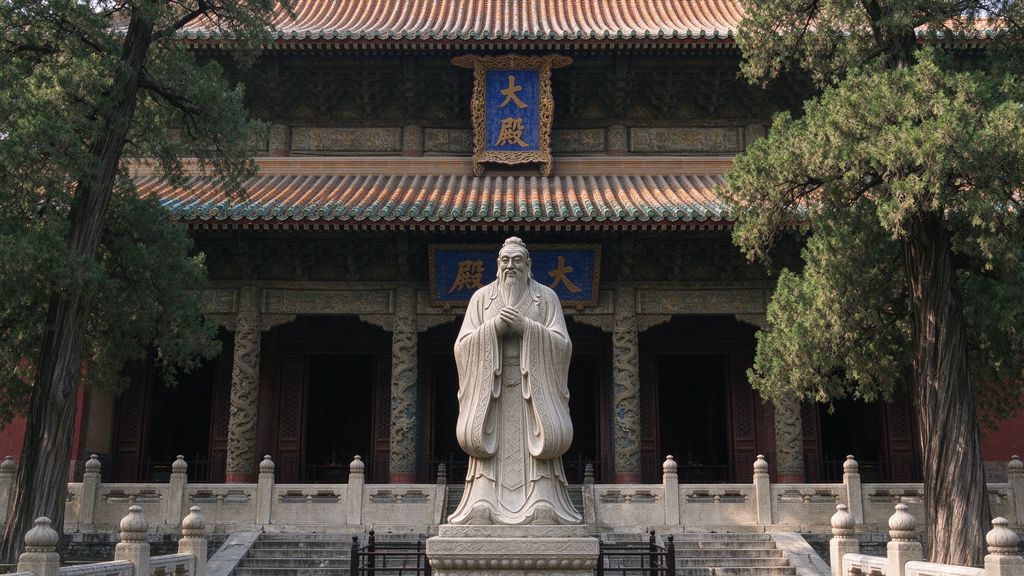
Confucius (551-479 BC) was a philosopher and educator of the Spring and Autumn period, founder of Confucianism, honored ever since as the "Supreme Sage and Foremost Teacher".
Core ideas: ren (benevolence) and li (ritual order) are the twin pillars. "Do not do to others what you would not have done to you" is engraved in the United Nations hall — a global golden rule.
Education: "teaching without discrimination" — he took commoner students and is said to have had 3,000 disciples, 72 of them sages.
The Analects (Lunyu): notes on his words and deeds compiled by disciples — the first book for anyone learning Chinese thought, and a wellspring of everyday idioms.
Today: 500+ Confucius Institutes worldwide teach Chinese language and culture. His hometown Qufu (Shandong) preserves the vast Temple, Mansion and Cemetery of Confucius — a UNESCO site.
Confucius (551-479 BC), named Qiu, courtesy Zhongni, was the greatest Chinese thinker and educator. His Confucian thought shaped China for over two thousand years; he is called "teacher of ten thousand generations".
Born in the state of Lu (today Qufu, Shandong), he held minor office in youth, then devoted himself to teaching. He is said to have taught three thousand students, the best seventy-two called "seventy-two worthies".
His core idea is "ren" (benevolence). What is ren? He said "the benevolent love others" - care for others. "Do not impose on others what you yourself do not desire."
He also advocated "li" (ritual) - maintaining social order through etiquette and rules. If everyone does their proper part, society is harmonious.
For fourteen years he travelled through the states hoping to apply his ideas in government, often frustrated. But he never gave up, teaching along the way and spreading his thought.
In old age he returned to Lu, edited ancient classics including the Book of Songs and Book of Documents, and wrote the historical Spring and Autumn Annals. These became required reading for later scholars.
His sayings were recorded by students in the Analects (Lunyu) - a thin book of over ten thousand characters, yet among the most influential in China; countless idioms and famous sayings come from it.
Today Confucius Institutes span over a hundred countries, teaching Chinese and culture. Confucius has become the "spokesman" of Chinese culture going global.
Learning Chinese, you must know Confucius. Remember one line: "learn and practise often - is that not a joy?" - the first sentence of the Analects.
Confucius influence reaches into daily details: Chinese values of courtesy, filial piety and respect for teachers all come from his teaching. Two millennia later, his thought is not outdated but increasingly valued worldwide. Many foreign scholars say one must know Confucius to know China. If you too want to approach Chinese culture, start with the Analects - that thin book holds two thousand years of Chinese wisdom.
Read ten thousand books and travel ten thousand miles - the road Confucius walked is part of Chinese culture; welcome to walk it too.

