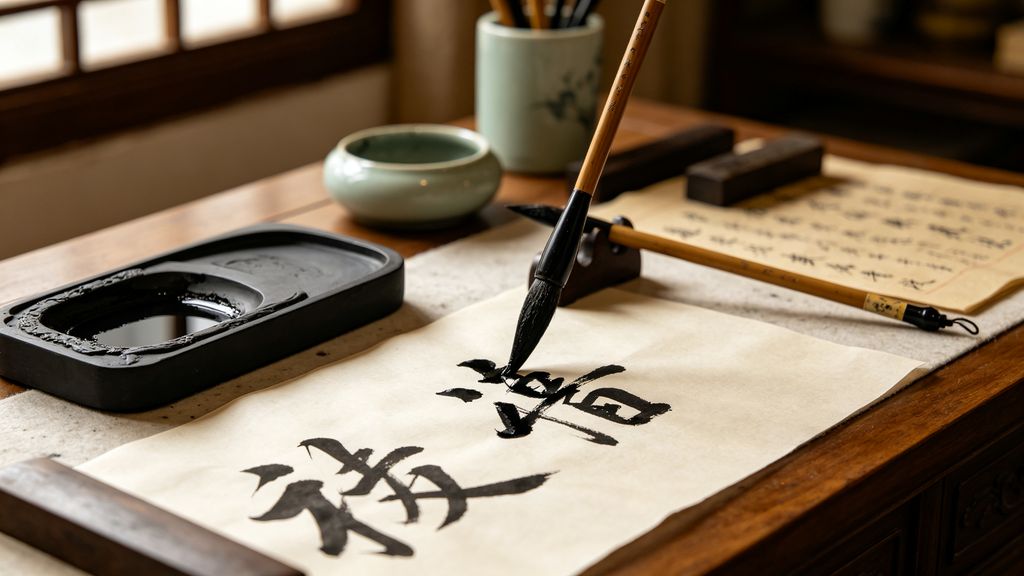
Calligraphy is an art form unique to Chinese characters: brush, ink, rice paper — and in the lines hides the Chinese sense of beauty and character.
The five scripts: seal script (earliest, rounded strokes), clerical (with its "silkworm head, swallow tail"), regular (the disciplined standard — where beginners start), running (fluid and lively; the Lanting Xu is "the world's finest running script"), and cursive (wild and free).
The "Four Treasures of the Study": brush, ink (ground from sticks), paper (xuan paper) and inkstone. Calligraphy is cultivation as much as art — "the hand reveals the person", so practicing characters trains the mind.
Everywhere in daily life: Spring Festival couplets, shop signs, menus, engravings on teaware — calligraphy is a living, daily art.
To try it: many cities have calligraphy experience studios where 30-60 minutes gets you a picture of your own name; a four-treasures set is the most cultured souvenir.
Calligraphy is the art of writing. Chinese people pursue writing as an art - unique in the world. A brush, a sheet of rice paper, a little ink: endless beauty emerges.
Chinese characters are square, built from strokes: dot, horizontal, vertical, left-falling, right-falling. The same character written with different brushwork feels entirely different. Calligraphers use pressure, speed, wetness and dryness to express mood.
There are several script styles: seal script is oldest with rounded lines; clerical is square and ancient; regular script (kaishu) is standard and orderly, the basis of learning; running script is fluid, between regular and cursive; cursive is freest, dancing and unrestrained.
Famous calligraphers include Wang Xizhi, Yan Zhenqing and Ouyang Xun. Wang Xizhi Lanting Preface is called "the best running script under heaven"; for a thousand years learners have copied it.
The tools are the "Four Treasures of the Study": brush, ink, paper, inkstone. Good brushes are "sharp, even, round, sturdy"; good ink smells fragrant when ground; rice paper absorbs ink giving layers; the inkstone grinds the ink.
Learning calligraphy is not only learning to write but cultivating the self. The ancients said "the character shows the person" - from your writing one sees your character and cultivation. Practice requires calm; stroke by stroke, no rushing.
Today many foreigners are interested. If you want to try, remember: "shūfǎ" calligraphy, "máobǐ" brush, "mò" ink, "kǎishū" regular script. Start with the character "yǒng" - it contains the eight basic strokes, hence the "eight strokes of yong".
Writing a good hand is a lifetime lesson for Chinese; appreciating calligraphy is one of the fastest ways to understand Chinese culture.
Many still practise calligraphy today: elders write with large water-brushes on pavement in parks, pupils have weekly calligraphy classes, young people treat it as relaxation. Calligraphy links Chinese spiritual worlds past and present. If interested, start with tracing - stroke by stroke, you will slowly love this "quiet beauty".
A simple way to appreciate calligraphy: first look at "balance" - even spacing, stable centre, like a person standing firm. Then "rhythm" - strokes flowing continuously, natural as breathing. Finally "character": Wang Xizhi elegant, Yan Zhenqing grand, Liu Gongquan forceful. The writing shows the person. Next time you see calligraphy, try these three angles and discover a new world.

