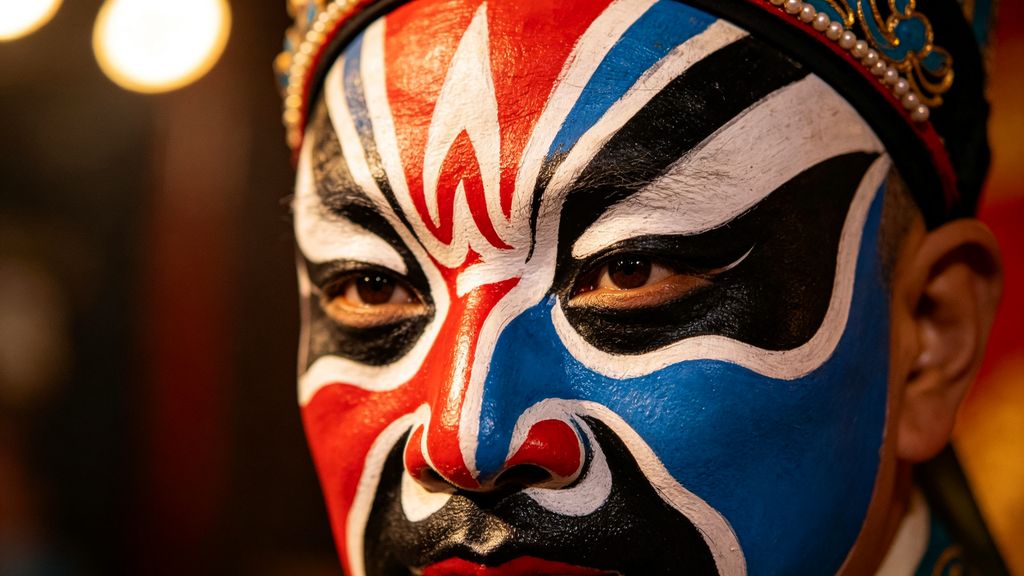
Peking Opera masks are the face paintings worn by opera performers, an important part of stage performance. Masks serve two purposes: shaping the character—using exaggerated colors and patterns to paint personality, identity, and age on the face; and helping the audience understand—one look at the face tells you if this character is good or bad.
Mask colors have many types, each with its own meaning. Red usually represents loyalty and justice, like Guan Yu. White represents treachery and suspicion, like Cao Cao. Black represents integrity and uprightness, like Bao Zheng. Blue represents boldness and bravery, like Dou Erdun. Yellow represents fierceness and irritability. Green represents chivalry and boldness. Gold and silver represent gods and spirits.
Mask patterns are also meaningful. A taiji diagram on the forehead means Taishang Laojun. A whole butterfly painted on the face means a clever character. A tiger painted on means a brave general. Each mask is a painting, depicting the story of that character.
Mask painting is very complex. A main character's mask takes one to two hours, with dozens of colors, applied stroke by stroke. Makeup starts with a clean face, then a base layer, then outlines, then colors, then setting. Actors have to redo their makeup several times a day—tiring but very detailed.
Today, Peking Opera masks have become a symbol of Chinese culture. You see them everywhere—on T-shirts, postcards, fridge magnets, souvenirs. If you go to a Peking Opera performance, look closely at the actors' faces—you'll find they really "speak"—one look at the color and pattern, and you know what kind of person this character is.
Peking opera face painting is the pattern painted on actors faces. One face is a "manual" of the play - the audience knows the character personality at a glance.
Colours carry meaning: red for loyalty, like Guan Yu, red face, black beard, imposing; black for uprightness, like Judge Bao, black face with crescent, impartial; white for treachery, like Cao Cao, a white face that instantly warns you.
Besides red, black and white: blue for bravery, green for rashness, yellow for ferocity, gold and silver for gods and demons. The deeper the colour, the stronger the character.
Patterns tell stories: the crescent on Judge Bao forehead symbolises judging the living by day and the dead by night; a black line on Guan Yu face is said to mark his quick temper. Every detail has a source.
Face painting is not just makeup but art: it is an independent painting art; many paint faces on fans, porcelain plates and bookmarks as souvenirs.
When watching Peking opera, "read" the face first: guess personality by colour, story by pattern. A red-faced man appears - you roughly know he is a good hero.
The most fun is "face changing", a Sichuan opera specialty, not Peking opera. But Peking opera makeup is also magical: actors paint for hours backstage, then step on stage as another person.
If you like faces, buy a face-painting mask or album. Remember: "liǎnpǔ" face painting, "hóngliǎn" red face, "hēiliǎn" black face.
One face is a "Chinese business card": colours hold good and evil, patterns hold stories, lines hold centuries of stage life.

