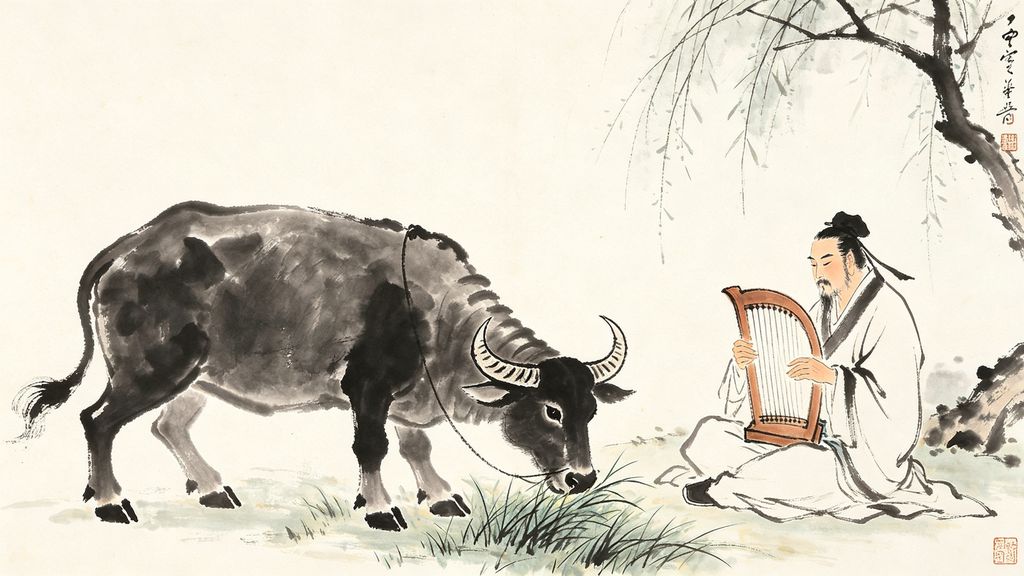
In ancient times there was a musician named Gongming Yi who played the zither beautifully. One day he saw a cow grazing in the meadow and started playing to it. He played a very elegant piece, the melody beautiful and moving.
But what did the cow do? It just kept its head down eating grass, no reaction at all. It wasn't that the cow didn't hear—it just couldn't understand such elegant music. The cow only had eyes for grass; no matter how well you played, it wasn't interested.
Gongming Yi tried another tune, imitating a calf's call. Now the cow reacted—it lifted its head, pricked up its ears, and listened carefully. Because this sound it could understand, something related to its own life.
Gongming Yi sighed and said: "Playing the harp to a cow—it's not that the music is bad, it's that the listener is wrong!"
This is the story of "playing the harp to a cow." It means reasoning with someone who doesn't understand, or talking insider talk to an outsider. Now it's also used to mock people who don't consider their audience. When we speak and act, we should consider the audience—say the right things to the right people. Otherwise, no matter how right your reasoning is, people won't listen.
The tale: an ancient musician Gongming Yi played the qin beautifully. One day he saw an ox grazing, and inspired, played it a refined tune.
But the ox kept its head down, ignoring him. Disappointed, he later realised the ox had feelings but did not understand refined music - so he imitated ox sounds, and the ox raised its head to listen.
The story comes from Mou Rong Han-dynasty Lihuo Lun. "Duì niú tán qín" became a famous Chinese idiom.
It means: reasoning with someone who cannot understand wastes effort. It teaches that communication must fit its audience.
Today it reminds us: choose words for the listener. With children, a story beats a lecture; with new Chinese learners, simple words beat idioms.
It also urges empathy: if the other "does not understand", they are not necessarily dull - maybe we did not speak in a way they can grasp.
For learners it is practical: know your listener level first, speak in ways they understand, and communication works.
Remember: play the qin for connoisseurs, speak to fit your audience - good communication uses the listener language for mutually useful words.
It reminds us: the goal of communication is not "I spoke" but "the other understood". The same meaning needs different words for different people.
It is practical for learners: chatting with Chinese people, if they do not understand, do not rush - rephrase simply or give another example.
The wisdom of communication is not beautiful words but comfortable understanding. Achieve that, and your Chinese truly works.
"Playing the qin to an ox" teaches knowing your audience, but also not to underestimate the "ox". An old saying: "great wisdom looks like folly" - the truly wise often look a little dull. The musician finally imitated ox sounds and the ox listened, showing he found a way to communicate. The lesson: when communication fails, do not blame the other first; question your own method. Change the way, and you may play music the ox hears.

