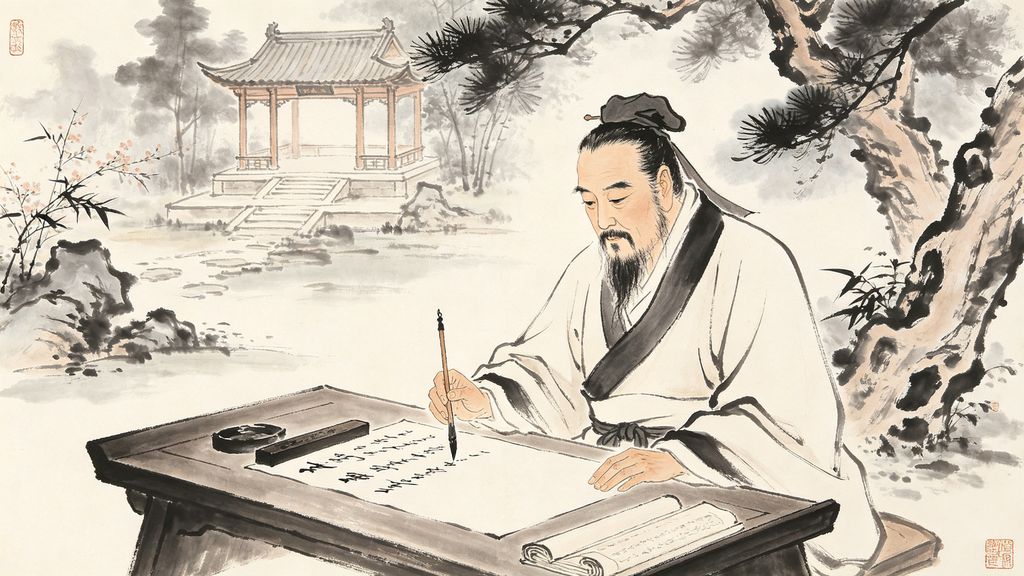
Wang Xizhi (303-361), courtesy name Yishao, was a famous calligrapher of the Eastern Jin dynasty, honored as the "Sage of Calligraphy." He was born into the prominent Langya Wang clan, served as General of the Right Army, so people also call him "Wang Youjun." His calligraphy excels in clerical, cursive, regular, and running scripts, breaking free from Han-Wei styles and creating his own school.
Wang Xizhi's most famous work is the "Lanting Xu" (Preface to the Poems Collected from the Orchid Pavilion). On March 3rd of the 9th year of Yonghe (353 AD), Wang Xizhi and 42 friends, including Xie An, gathered at Lanting in Kuaiji for the spring purification festival. They drank wine and composed poems; Wang Xizhi wrote a preface on the spur of the moment—this is the "Lanting Xu." 28 rows, 324 characters, written in one breath. Among them are over twenty "zhi" characters, each one different.
Legend says when Wang Xizhi was young and practiced calligraphy, he blackened the pond in front of his house—this is the allusion of "studying calligraphy by the pond." He also loved geese, feeling that their movements were beautiful and could inspire his brushwork. A Daoist priest raised a flock of fine geese; Wang Xizhi loved them so much that he copied a whole "Daode Jing" for the priest in exchange for the geese—the story of "Xizhi loving geese."
Wang Xizhi's calligraphy has influenced China for over 1,600 years. Tang dynasty masters like Ouyang Xun, Yan Zhenqing, and Liu Gongquan, and Song dynasty masters like Su Shi and Huang Tingjian, all studied Wang Xizhi. Emperor Taizong of Tang loved Wang Xizhi's calligraphy so much that he had the original "Lanting Xu" buried with him in his Zhaoling Mausoleum. So the "Lanting Xu" we see today are all Tang dynasty copies.
Wang Xizhi's story tells us: even genius needs hard work. He wasn't born a great calligrapher—he practiced diligently from childhood, "studying by the pond," to become the "Sage of Calligraphy." Whatever you learn, hard work is the eternal truth.
Wang Xizhi (303-361), Eastern Jin calligrapher, is honoured as the "Sage of Calligraphy". His running-script masterpiece Preface to the Orchid Pavilion is called "the best running script under heaven" - the supreme model of Chinese calligraphy.
Legends of practice: he began learning calligraphy at seven, practising daily by a pond and washing his brushes in it until the clear water turned into an "ink pond". So focused was he that he once dipped his steamed bun in ink instead of garlic paste and ate it, mouth blackened, unaware. The stories tell us: behind genius lies diligence few can imagine.
The Orchid Pavilion story: on the third day of the third month, 353 AD, Wang Xizhi and 41 worthies gathered at the Orchid Pavilion in Kuaiji to float wine cups along a winding stream and compose poems. Asked to write the preface, drunk with inspiration he dashed off 324 characters of flowing, graceful script - the "first running script under heaven".
Why it is so hard to surpass: its beauty lies in naturalness - not crafted but spontaneous. Wang himself later rewrote it many times, never matching the original. Emperor Taizong of Tang treasured the original so much that he ordered it buried with him at Zhaoling; the true work is lost, and only Tang copies survive (the Shenlong version is closest).
Influence: his son Wang Xianzhi was also a master; father and son are called the "Two Wangs". Every later calligrapher entered through them. He set the aesthetic standard for running, regular and cursive scripts - the unshakeable founder of Chinese calligraphy.
Places: the Orchid Pavilion scenic area in Shaoxing (Goose Pond, winding-stream site, imperial steles), the Palace Museum in Beijing holding the Shenlong copy of the Preface (shown occasionally), and copies of the Two Wangs works in museums across China.

