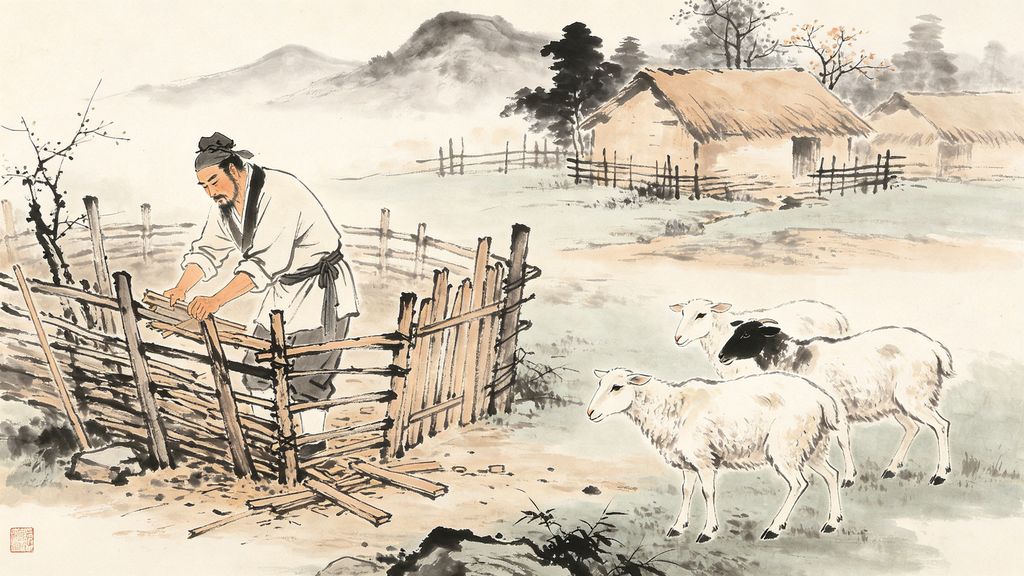
Once there was a man who kept a flock of sheep in a pen. One morning he counted them and found one missing. He checked the pen and found a hole—a wolf had come through at night and snatched a sheep. His neighbor advised: "Hurry up and fix the pen!"
The man said: "The sheep is already gone, why fix the pen?" He ignored the neighbor's advice. The next morning, he counted again and found another sheep missing—the wolf had come back through the same hole and taken another one.
Now he regretted not listening to his neighbor. He quickly patched the hole and reinforced the whole pen. From then on, he never lost another sheep.
This is the story of "Mending the Fold After Losing Sheep." "Wang" means lose, "Lao" means pen. It means fixing the sheep pen after sheep are lost—taking remedial action after a problem to prevent further losses.
This idiom teaches us: it's okay to make mistakes; what's bad is not correcting them. Making mistakes and experiencing setbacks is common. As long as you learn your lesson and take timely corrective action, you can avoid further mistakes and greater losses. "Mending the fold after losing sheep is not too late" says exactly this.
Everyone has heard the story: a shepherd loses a sheep when a hole appears in the pen. A neighbour urges him to fix it; he says "the sheep is lost; what use is fixing?"
The next night, another sheep is lost. Only then does he regret, fixing the pen quickly. From then on, no sheep is lost.
The story comes from Zhanguo Ce, answering exactly this question: is it too late to mend after losing sheep? The answer: no - because only the first and second are lost; with the pen mended, the rest are saved.
The key is not "the lost sheep" but "mending the pen". It tells us: when a problem arises, remedy at once is never too late; what is truly late is doing nothing at all.
Life is full of such moments: fail an exam, catch up, improve next time; small health issues, check and treat promptly before they grow; cracks in relationships, communicate in time to repair.
The opposite is "hiding an illness for fear of treatment" - pretending all is well, letting small problems become big ones.
For learners this idiom is powerful: starting effort at any time is never too late. Studied less today? Study more tomorrow. Missed this month target? Keep chasing next month.
Remember: losing sheep is fine; what matters is mending the pen. Life is the same - mistakes are not terrible; refusing to correct is.
"Mending the fold" and "repairing the roof before rain" are partners: one teaches timely remedy after problems, the other preparation before. Prepare first, and you will rarely need to mend.
In Chinese study both help: daily review is preparing; correcting a mispronunciation at once is mending.
Remember the scene: pen, hole, lost sheep, repair. Next time you err, tell yourself: "Wang yang bu lao, wei shi wei wan" - it is never too late to mend.

