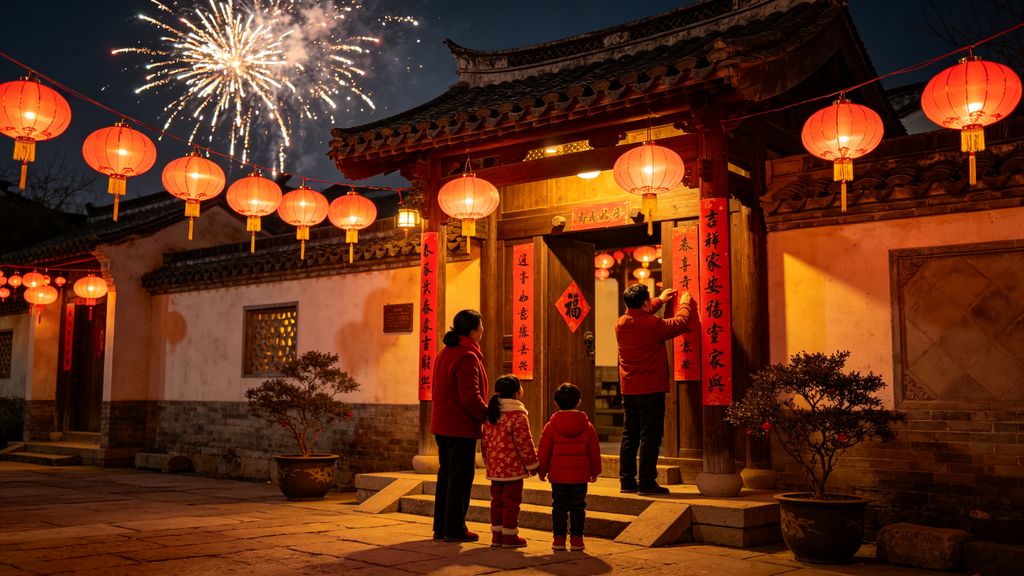
The Spring Festival, also known as Chinese New Year, is the most important holiday in China. No matter if you are working in a city thousands of miles away or studying abroad, when Spring Festival comes, you will find a way to go home. It is more than just a few days off—it is a deep-rooted cultural tradition: celebrating the New Year means a family reunion with a big dinner.
The history of the Spring Festival spans over 4,000 years, dating back to ancient year-end ceremonies. Legend says "Nian" was a monster that came out on New Year's Eve to harm people, so people used red couplets, firecrackers, and lanterns to scare it away. That is why today we put up red couplets, set off firecrackers, wear red clothes, and give children red envelopes—all these customs evolved from ancient exorcism rituals.
For Chinese people, the most important part of Spring Festival is not the holiday itself—it is going home. During the annual "chunyun" travel rush before the festival, Chinese railways transport hundreds of millions of people, and roads and airports are packed. No matter how hard it is to buy a train ticket, no matter how long the journey, people must be home by New Year's Eve. This chunyun phenomenon is unique in the world.
The New Year's Eve dinner is the highlight of Spring Festival. Northerners must eat dumplings because their shape resembles gold ingots, symbolizing wealth; southerners eat rice cakes because "cake" (gāo) sounds like "high," symbolizing progress year after year. Fish is also essential—"fish" (yú) sounds like "surplus," representing abundance. Every dish on the table has a hidden meaning.
If you ever have the chance to spend Spring Festival in China, give it a try: make dumplings with the family, watch the CCTV New Year Gala, set off firecrackers at midnight, and visit relatives on New Year's Day. You will find that Spring Festival is not just a lively holiday—it is the thread that binds Chinese families together. No matter how far you travel, Spring Festival always brings everyone back home.
Spring Festival is the most important Chinese holiday. On the first day of the first lunar month, over a billion Chinese celebrate at once. The theme is single - going home, reunion.
Why must Chinese go home? Because Spring Festival is the festival of "family". Those working away all year, however far or hard the journey, hurry back before New Year eve for the reunion dinner.
The way home is the most spectacular road on earth: during chunyun, billions of trips happen in about two weeks. Train tickets scarce, flights doubling, highways jammed - but all hardship is worth it the moment you see family.
Preparation starts in the twelfth lunar month: laba porridge on Laba day, kitchen god worship on the 23rd, then cleaning, shopping, couplets, window flowers. Homes turn red; festive mood thickens.
New Year eve is the climax: reunion dinner, the CCTV gala, staying up to welcome the year. At midnight, firecrackers roar, fireworks light the sky, everyone wishes each other "new year good".
First day: new clothes, New Year greetings. Children love red envelopes; elders love seeing the whole family together. Second day to visit mother family, then relatives, until the Lantern Festival ends the holiday.
For Chinese, Spring Festival is not "days off" but "falling back into formation" - into the ranks of family, beside loved ones. The meaning of home is magnified countless times.
If you spend the festival in China, do not miss: making dumplings, posting couplets, watching fireworks together. Remember: "huíjiā guònián" (going home for the New Year) - the most affectionate Chinese sentence.
Spring Festival is the reason Chinese go home and the longing in their hearts. However big the world, they go home.

