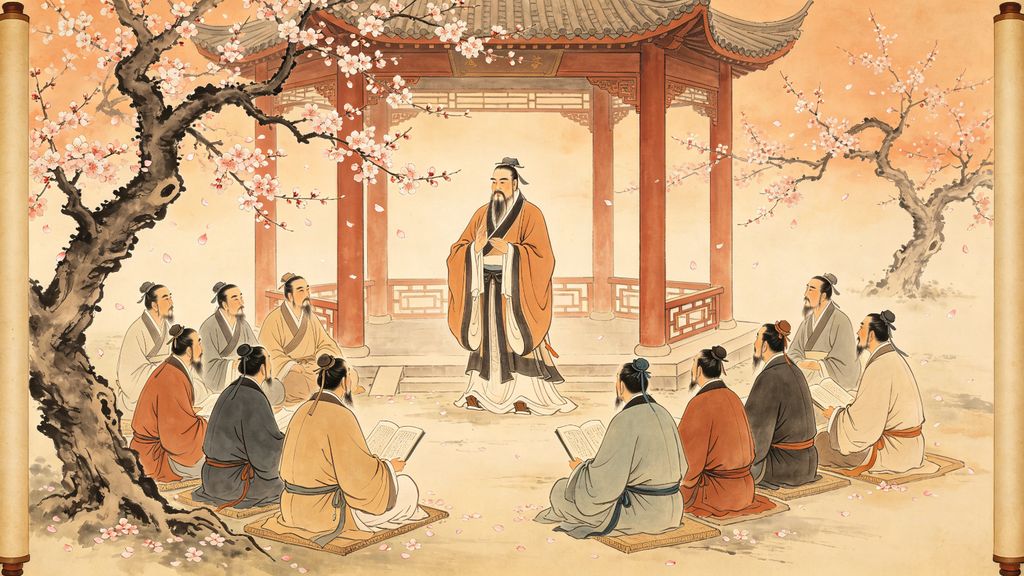
Confucius lived over 2,500 years ago during the Spring and Autumn Period. He grew up poor but loved learning. At thirty, he did something unprecedented: he opened a private school open to anyone, regardless of background.
His students came from all walks of life: poor and rich, nobles and farmers. He taught them how to be good people: respect your parents, be honest, and have manners.
Confucius often said: "Do not do to others what you do not want done to yourself." This phrase is still written in classrooms today.
After he died, his students wrote down his teachings in a book called the Analects. It has shaped Chinese culture for over two thousand years and is still widely read today.
Confucius (551-479 BC) is the greatest thinker and educator of China, founder of Confucianism and honoured as the "Supreme Sage and Foremost Teacher". His thoughts and words in the Analects deeply shaped Chinese values and influenced all of East Asian civilisation.
His life: personal name Qiu, courtesy name Zhongni, from Zouyi, Lu state (today Qufu, Shandong). Born to a declining noble family, orphaned young and poor, he studied diligently. He held minor posts managing granaries and herds, then began teaching - 3,000 disciples, 72 masters. In later years he travelled 14 years among states seeking to implement benevolent governance; failing, he returned to Lu to edit classics and teach.
Core ideas: ren (benevolence - love others; do not do to others what you would not want done to you); li (ritual and social norms); yi (righteous action); zhi (discernment); xin (trustworthiness). He championed education for all and teaching according to each student aptitude.
Analects lines everyone knows: "Is it not a joy to learn and practise what you have learned?", "When three walk together, one of them can be my teacher", "Reviewing the old produces new understanding."
Confucius and the world: Confucianism shaped Korea, Japan and Vietnam; over 100 countries host Confucius Institutes teaching Chinese and spreading culture; UNESCO awards a Confucius Prize for Education.
Visits: the Three Kongs in Qufu (Temple, Mansion, Forest) are World Heritage; the grand ceremony on his birthday, September 28; Beijing Guozijian and Nanjing Fuzimiao are also key memorial sites.
A fun fact about Confucius: he was very tall (records suggest about 1.9 m) and strong, skilled at archery and charioteering - no frail scholar but a "Shandong giant" with both literary and martial arts. Among the Six Arts (ritual, music, archery, charioteering, calligraphy, mathematics), archery and driving were sports. Confucius was truly a pioneer of all-round development.
The most modern of Confucius educational ideas is teaching according to aptitude: the bold but impulsive Zilu was counselled to be cautious; the timid Ran You was encouraged to be brave. The same question gets different answers for different students. Today educators still study personalised teaching, which Confucius was already practising 2,500 years ago - why he is called the "teacher of ten thousand generations".

