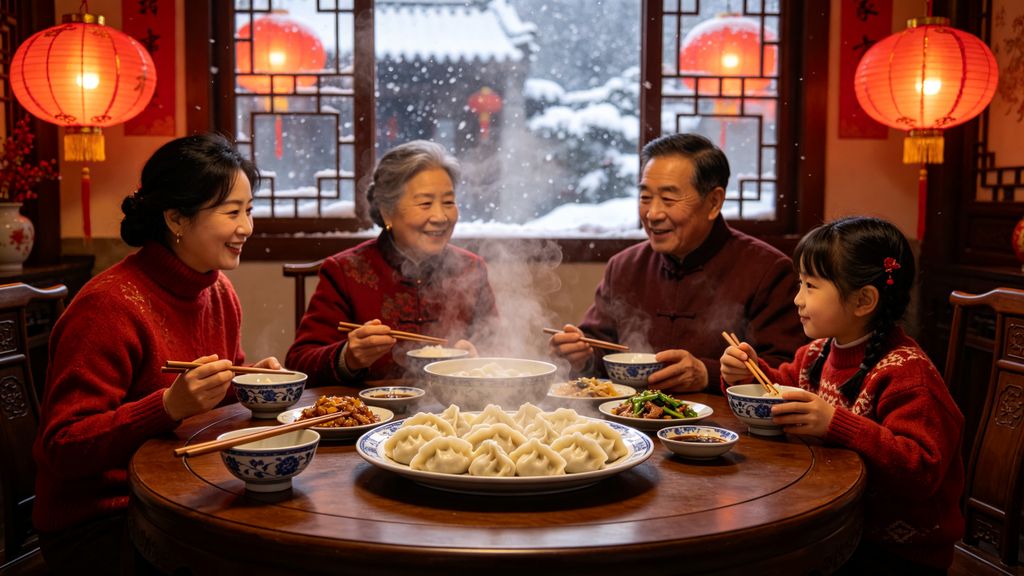
Every Chinese New Year's Eve night, homes across northern China follow the same ritual: when the clock strikes midnight, the whole family gathers around a table to make dumplings. Pork and cabbage are wrapped in dough, folded into crescent shapes, and dropped into boiling water. Steam fogs up the windows.
Why dumplings in particular? Legend says they were invented in the Eastern Han dynasty by physician Zhang Zhongjing, who created them as a "cold-dispelling ear-warming soup" to heal people's frostbitten ears. Eating dumplings every Winter Solstice and New Year's Eve became a way to remember him and wish for warm ears.
Dumplings look like ancient Chinese silver ingots, so eating them at New Year also means "bringing in wealth." Some families hide a coin inside one dumpling; whoever finds it gets the best luck all year.
Today dumplings are more than food—they are a signal of reunion. No matter how busy the year has been, sitting with family on New Year's Eve to wrap a plate of dumplings is what truly counts as "going home for the holidays."
The New Year dinner is the most important meal of the Chinese year. On Lunar New Year eve the whole family sits together, dishes covering the table, and dumplings are never missing.
Why dumplings? The most popular explanation: dumplings look like gold ingots (yuanbao), so eating them means "attracting wealth". The first bite of the new year is an "ingot", hoping wealth flows in.
Another relates to "gēng suì jiāo zǐ": the old and new years meet at zishi (11pm-1am); "jiǎozi" sounds like "jiāo zǐ", so dumplings mean "bidding farewell to the old, welcoming the new".
Fillings carry wishes: cabbage sounds like "hundred wealth", celery means diligence, chives sound like "long wealth". Families hide a coin in one dumpling; whoever finds it is luckiest in the new year.
Making dumplings is a family activity: someone kneads dough, someone rolls wrappers, someone fills them. Chatting while the Spring Festival gala plays on TV. Children make odd-shaped "little ingots", making everyone laugh.
Northerners cannot do New Year without dumplings; southerners prefer nian gao (rice cake) and tangyuan. Nian gao sounds like "year high", meaning rising step by step; tangyuan is round, meaning reunion.
Dumplings are eaten with vinegar, often with garlic paste and soy sauce. Fresh from the pot, thin wrapper, big filling - one bite, hot juice flows. That is the taste of "year".
If you spend New Year in China, taste dumplings. Remember: "jiǎozi" dumplings, "niányèfàn" New Year dinner, "tuányuán" reunion. This plate of dumplings is China deepest attachment to home.
The meaning of the New Year dinner is not many dishes but reunion - a family together is more precious than anything.
A warm detail of the New Year dinner: elders put food on younger plates, saying "eat more, grow tall"; younger ones toast elders, wishing "health and long life". One dinner holds Chinese filial piety and family love. If you ever celebrate New Year at a Chinese friend home, sit at that round table - you will feel what Chinese call "the taste of home".
A reunion dinner, a reunion year - may you always have a round table kept for you.

