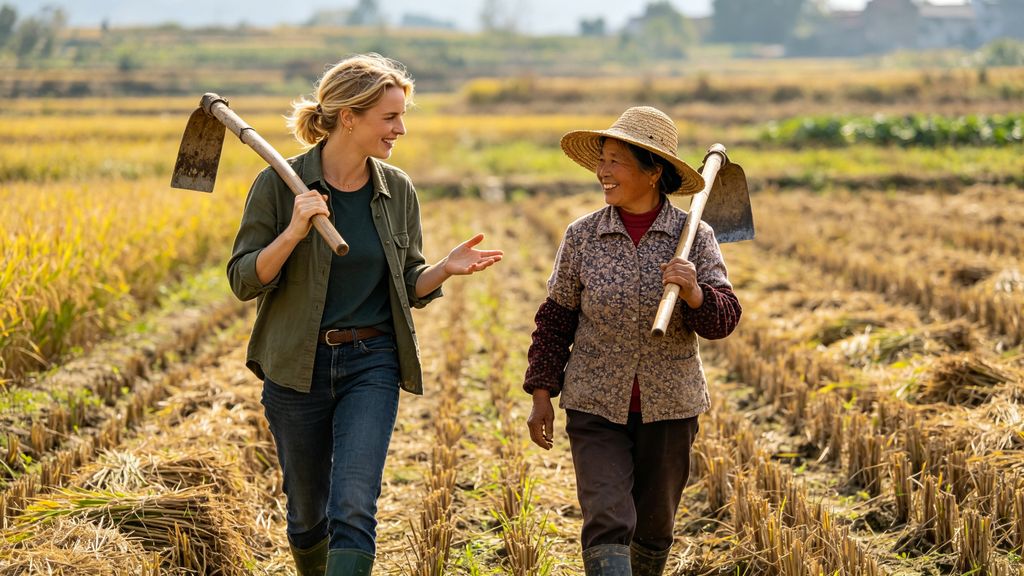
In a small village in southeastern China, blonde Amy carries a hoe on her shoulder, walking along the ridge of a rice paddy beside Aunt Li, who wears a straw hat. The rice is golden; smoke rises from distant chimneys. It is her third year living in the Chinese countryside.
Amy used to teach English in Shanghai. On a weekend trip, she fell in love with these rice fields, moved into the village, and began learning to farm from Aunt Li. "The city taught me work; the countryside taught me life," she says.
At first she could not understand the local dialect and could barely swing the hoe. Aunt Li taught her step by step: transplanting seedlings, fertilizing, harvesting. Slowly they became the closest of partners. Villagers stopped calling her "that foreigner" and began to call her "Xiao Ai" — a warm, familiar nickname.
At harvest time, the whole village dries rice together. Amy bargains and chats in still-imperfect Chinese, laughter echoing across the fields. The real China, she says, is not in skyscrapers but on the field ridges, at the dinner table, and in people's smiles.
A foreign girl life record in rural China - giving up a city apartment for an old house beside rice paddies, farming, cooking and market-going with villagers, turning days into a "pastoral poem".
Her choice: she worked in a big city until a trip made her fall for Chinese villages; she decided to stay. "Cities have much glitter, but the four seasons of rice paddies bring more peace of mind."
Her village days: learning rice transplanting, grain drying and pickling with neighbours; waking to roosters, walking paddy paths at dusk; carrying a bamboo basket on market days, bargaining with vendors.
Observations: "the village taught me two things - how hard grain is earned, and how simple and sincere people are." Villagers constantly share food and help each other; this "acquaintance society" moved her.
Content: she films village life - spring ploughing, summer busy season, autumn harvest, winter storage, plus village children, elders and dogs. Viewers: "watching her calms my heart."
Significance: she represents foreigners living in rural China - showing happiness need not be urban; fields can heal.
Plans: editing a year of village life into a short film, Rice Paddy Diary.
For readers: her records make you re-see Chinese villages - no anxiety there, only land, sunshine and people living seriously.
She records small beauties: spring wild vegetables with neighbours, summer well-chilled watermelon, autumn new-rice porridge, winter sweet potatoes by the stove. "The turning seasons are the village oldest calendar." Villagers are curious and kind - children call her jiejie, elders teach her dialect. "Here I am not a guest but part of the village." She plans to bring her mother next year to see her "second home" in rural China.
She learned transplanting and grain drying; neighbours call her to help in busy seasons and she works well. "My hands are tanned, but my heart is brighter."

