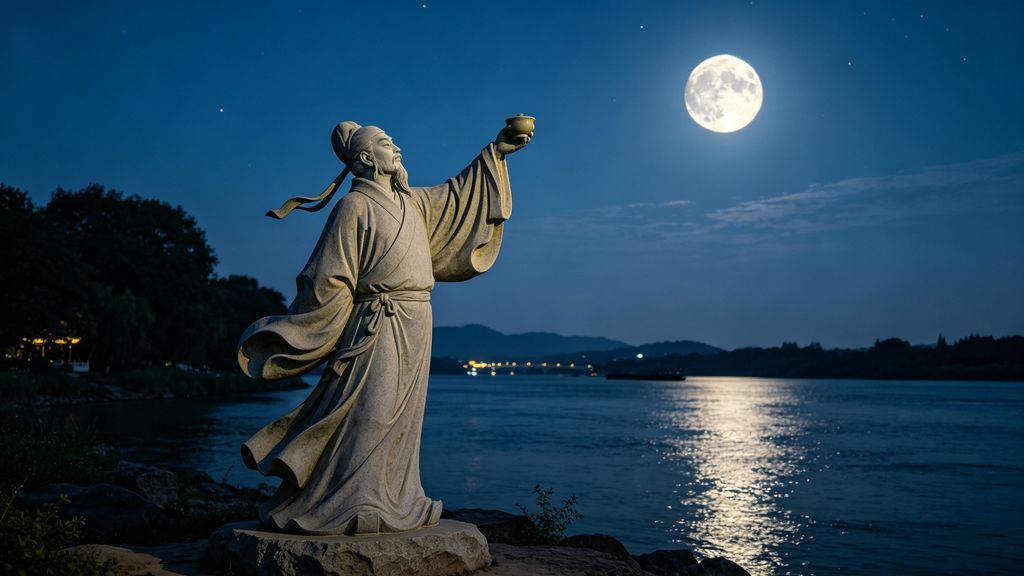
Li Bai (701-762), the Tang dynasty poet known as the "Poet Immortal", left nearly a thousand poems of bold, freewheeling style.
Famous works: Jing Ye Si ("bright moonlight before my bed"), Looking at the Waterfall on Mount Lu ("flying straight down three thousand feet"), and Invitation to Wine ("my talents given by heaven will be useful").
Legendary life: he roamed with a sword in youth, served briefly at court as a Hanlin academic, was pushed out for his wild ways, and legend says he drowned reaching for the moon after drinking.
Style: astonishing imagination, grand exaggeration, loving wine, moon, swords and mountains - romantic hyperbole like "three thousand feet of white hair".
Places: his hometown Jiangyou, Sichuan; his tomb in Dangtu, Anhui; and Mount Lu, source of his waterfall poem.
Reading: start with Jing Ye Si, then Invitation to Wine for the wild side; bilingual editions abound - pair with calligraphy images.
Li Bai (701-762), courtesy Taibai, is one of China greatest poets, called the "immortal poet". He wrote nearly a thousand poems, each bright as moonlight.
Born in present-day Kyrgyzstan, he moved to Sichuan at five. Clever and studious, he loved swordsmanship and wine - legend says he wrote a hundred poems after a measure of wine.
His poetry hallmark is romance: wild imagination, majestic force. Writing a waterfall: "flying down three thousand feet, one would think the Milky Way falls from heaven."
Writing the moon: "raise head to gaze at the bright moon, lower head and think of home." This Quiet Night Thought is the first poem every Chinese child learns.
He once went to Chang An, met the emperor and held office, but disliked official restraint and preferred freedom. Resigning, he travelled across China great mountains and rivers.
He loved hyperbole, yet natural and charming. Of himself: "white hair three thousand zhang, because sorrow is so long." Others wrote sorrow as bitter; he wrote it grandly.
Li Bai and Du Fu were friends, together called "Li Du". If Du Fu poetry is heavy as earth, Li Bai is free as sky.
His influence spans the world: his poems are translated into dozens of languages, loved in Japan, Korea, Europe and America. The image of him on horseback, sword, wine and verse is the Chinese embodiment of "freedom".
Chinese learners must read Li Bai. His poems are short, beautiful and smooth - the best material for pronunciation practice and feeling poetry.
Li Bai poetry also teaches an attitude to life: sing over wine, be free and easy. Chinese read him when downcast and regain courage; read him when proud and stay magnanimous. He wrote "heaven gave me talent, it must be used; a thousand gold spent will come again" - such confidence has encouraged generation after generation. As a Chinese learner, when you feel tired one day, read a Li Bai poem and you will fall in love with Chinese again.
May the moon of Li Bai light the way for everyone learning Chinese.

