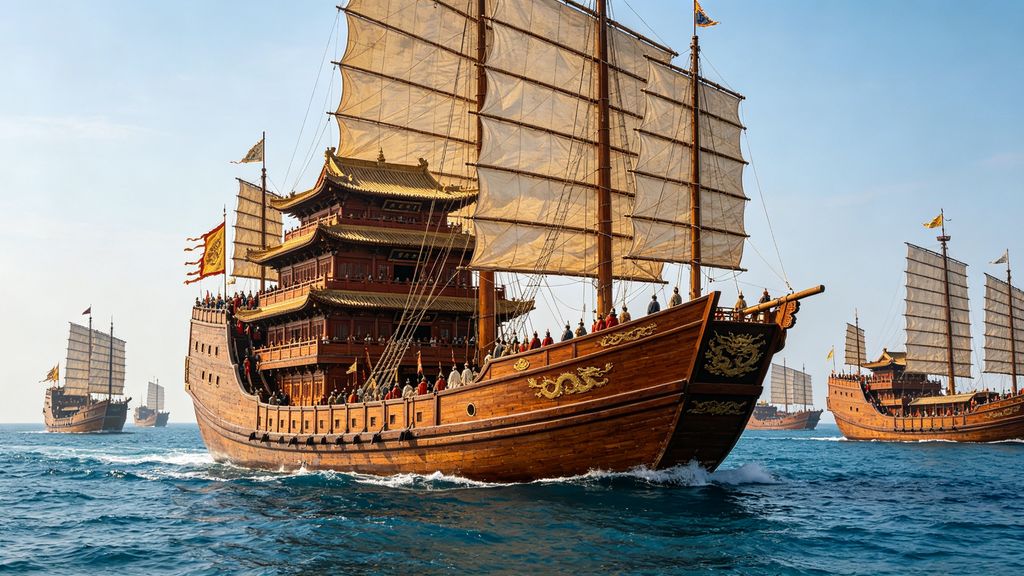
From 1405 in the Ming dynasty, Zheng He led a huge fleet west seven times — to Southeast Asia, India and Africa. The largest ships were longer than a football field; the fleet had over 200 vessels and more than 27,000 people.
Zheng He sailed over 80 years before Columbus. He did not conquer lands or take slaves — he gave gifts, traded and made friends, carrying silk, porcelain and tea abroad and bringing back spices, gems and animals.
His story lives on across Southeast Asia: Malaysia has a "Sam Po Temple", Indonesia a city called Semarang. Zheng He's voyages were the earliest "maritime Silk Road".
Zheng He seven voyages (1405-1433) were an unprecedented feat in maritime history: he led a huge fleet on seven expeditions reaching as far as the East African coast, nearly 90 years before Columbus reached the Americas (1492), and on a far larger scale.
Fleet size: the first voyage had 62 treasure ships and about 27,000 people. The largest treasure ship was about 44 zhang long (over 120 m in Ming measures) - the biggest wooden vessel of its time, roughly the length of a modern mid-rise office building.
Routes: departing Nanjing via Liujiagang (Taicang) and Changle in Fujian, south through Southeast Asia (Java, Sumatra), through the Strait of Malacca to India (Calicut, Cochin), to the Persian Gulf (Hormuz) and Arabia (Mecca), and as far as East Africa (Mogadishu).
Significance: nearly a century before European expansion, it showed Ming power and maritime technology; but it was mainly peaceful diplomacy - trading gold, silk and porcelain, building friendly ties, not conquering like later colonial powers.
Why it ended: after Zheng He, the Ming imposed a maritime ban, stopped official voyages, and the treasure-ship blueprints and records were destroyed - China missed the Age of Discovery. It remains one of the most discussed regrets in Chinese history.
Today: Taicang Zheng He Park, Nanjing Zheng He Memorial and Changle historical hall are worth visiting; Jinning in Kunming, Yunnan is his hometown with statues and a museum. His voyages feature in several documentaries.
Two fun facts about Zheng He: first, his original surname was Ma; he was a Hui Muslim from Yunnan who was honoured with the surname Zheng for merit. Second, legend says the treasure ships carried giraffes - crew saw them in East Africa, mistook them for the mythical qilin, and brought one to the emperor. The story is unverifiable, but it shows the fleet did reach East Africa and Ming China was full of curiosity about the world.
Finally, connect Zheng He to today: the peaceful, win-win trade of his voyages is seen as the spirit of the ancient maritime Silk Road; the modern "21st Century Maritime Silk Road" initiative continues that tradition. Reading Zheng He is reading how China engages the world - valuing exchange over conquest, the core of China maritime outlook.
A practical tip for travellers: to explore Zheng He and the maritime Silk Road, visit the Zheng He Treasure Ship Relics Park in Nanjing (with ship models), the Zheng He Memorial in Taicang, and Quanzhou Overseas Transportation History Museum in Fujian (a Song-Yuan maritime Silk Road start point and World Heritage city). Quanzhou deserves a full day - its religious and trade relics are astonishingly dense.

