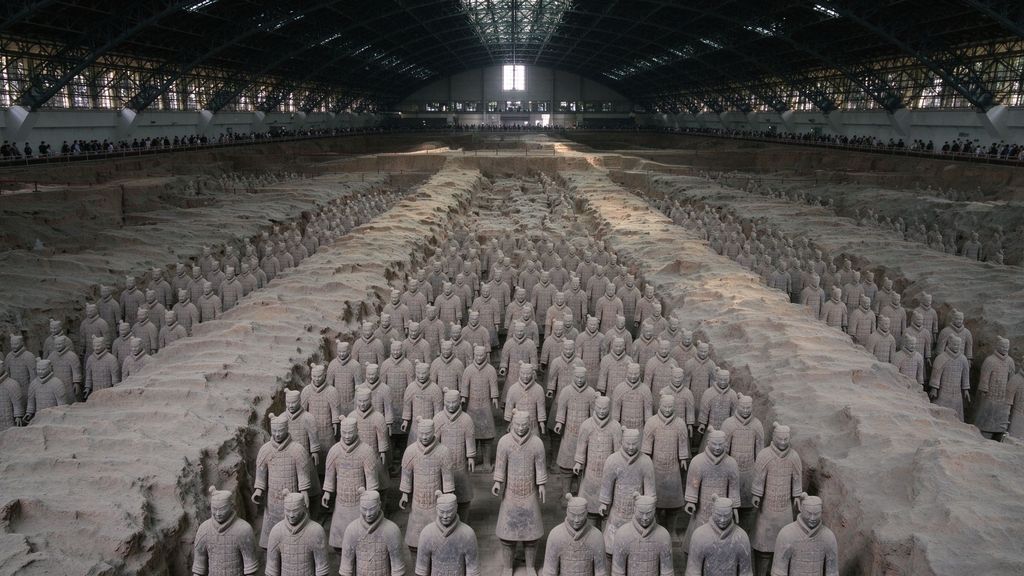
In 1974, farmers digging a well near Xi'an, Shaanxi, unearthed several clay heads. Archaeologists discovered a vast underground army: over 8,000 terracotta warriors, life-size, each one unique.
These figures were built for Qin Shi Huang, China's first emperor. He believed he would rule after death too, so craftsmen made him an army for the tomb. There are generals, infantry and archers, along with clay horses and chariots.
The warriors are displayed in Xi'an and are a World Heritage Site, often called the "Eighth Wonder of the World". When you visit, look at the faces — no two are alike.
The Terracotta Army is the burial pit of the Mausoleum of Qin Shi Huang, discovered in 1974 by farmers digging a well in Lintong, Shaanxi - since called the "Eighth Wonder of the World". Three pits have been excavated with about 8,000 figures, yet this may be only a fraction of the mausoleum.
They are pottery figures, not humans: each soldier stands 1.75-1.9 m tall, and no two faces are identical. Arranged in battle formation with generals, warriors, archers and charioteers, they reproduce the real Qin army structure.
Colour and detail: when excavated, the figures were painted (vermilion, mineral green, violet-blue), but the pigments oxidise and flake on contact with air, so most appear grey today. Archaeologists use new technology to preserve the remaining colour.
What to see: Pit 1 is the largest and most spectacular; Pit 2 holds the famous "green-faced warrior"; Pit 3 is the command post. The museum also displays two painted bronze chariots, exquisitely crafted and called the "crown of bronzes".
Practical info: ticket is RMB 120 (students half price); open 8:30-17:00 (extended in peak season); book online in advance and hire a guide or audio device, or you may just "watch the crowd".
Surroundings: the pits and the mausoleum belong to one site (Lishan Park) linked by shuttle; from central Xi an it is about an hour - Metro Line 9 to Huaqing Pool station, then a bus.
A question worth pondering: why did Qin Shi Huang need so many warriors? Scholars believe that after unifying the six states, he wanted his army to guard him in the afterlife. This "serve the dead as the living" concept makes the figures a precious archive of Qin military, clothing and hairstyles. Even shoe soles have anti-slip treads and armour plates differ by rank - details are where history comes alive.
A shopping warning: stalls outside the site sell terracotta souvenirs from a few yuan to hundreds, quality varies hugely - inspect carefully before buying. No flash photography inside (it accelerates pigment fading) - please follow the rules. For more Qin culture, Xi an also has the Mausoleum Museum (combined ticket) and the Emperor Qinshihuang Museum; pair them if time allows.
A detail that makes the site even more striking: weapons from the pits (bronze swords, arrowheads) remain sharp after 2,000 years, coated with a chromium oxide film - a chrome-plating anti-rust technique the West only mastered in the 20th century. Ancient craftsmanship ran far deeper than we imagine.

