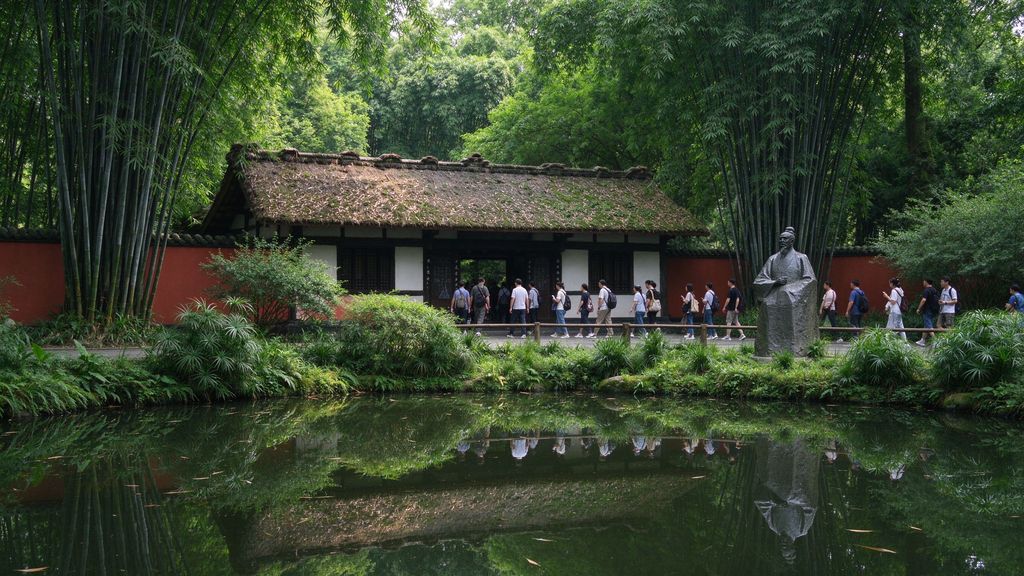
Du Fu (712-770), styled Zimei, is the great Tang poet honoured as the "Saint of Poetry". Eleven years younger than Li Bai, his close friend, together they are "Li-Du".
Life: born into an official family, travelled young, then the An Lushan Rebellion (755-763) upended everything - years of wandering and witnessing war and suffering.
Style: "deep and restrained", a truthful chronicle of his age, earning the title "poetry of history"; his line "behind vermilion gates wine and meat rot; on the road, frozen bones" cuts to injustice.
Masterpieces: Spring View ("the nation broken, mountains and rivers remain"), Song of My Thatched Cottage ("where will a vast mansion shelter all the poor"), Climbing the Height ("boundless falling leaves rustle down") - eternal verses.
Why he matters: Li Bai is "genius romance", Du Fu "profound reality" - when wind tears his own roof, he dreams of shelter for the cold and poor.
See it: Du Fu Thatched Cottage in Chengdu (where he lived four years and wrote 240+ poems), Du Fu steles in Xi an Forest of Stone Steles, Yueyang Tower in Hunan (his famous poem).
Du Fu (712-770), courtesy Zimei, is the greatest realist poet of China, called the "sage of poetry". With Li Bai he is renowned as "Li Du".
He lived through the Tang decline from glory. Young, he wrote of soaring ambition - "climb to the summit and see all mountains small" - but after the An Lushan rebellion he witnessed war suffering first-hand.
His verse records a real era: "wine and meat rot behind vermilion gates, frozen corpses lie by the roadside" - lines that still shake readers over a millennium later.
His "Three Officials" and "Three Partings" series tell the fate of common people in war: a new recruit leaving home, an old man conscripted, a new wife sending her husband to battle. Each poem is heartbreaking.
In his late years he drifted to Chengdu and built a thatched cottage by the Huanhua stream - today the famous Du Fu Thatched Cottage. There he wrote "how to get ten thousand mansions to shelter all the poor and cold with happy faces".
Living in hardship himself, his heart held all the people. This "worrying before the world worries" breadth earned him "sage of poetry" - a saint within verse.
He and Li Bai were close friends. Li Bai free and romantic, Du Fu heavy and profound; Li Bai a cloud in the sky, Du Fu a mountain on earth. Together they show two sides of the Chinese character.
Today his poems are translated into dozens of languages. The BBC documentary Du Fu: China Greatest Poet introduced him systematically to Western audiences.
Reading Du Fu, you understand: true greatness is seeing other suffering. That is what the sage of poetry teaches the world.
Du Fu influence shows in daily language too: "Du Fu is busy" was once a hot internet topic, with his portrait photoshopped into all scenes - proof of how familiar everyone is with him. More importantly, Chinese teach children "only by bearing bitter hardship can one rise above others" - a resilient character that is the very spirit of his poetry. In Chengdu, visit the Du Fu Thatched Cottage - bamboo groves, a stream, poetic atmosphere. Reading Du Fu, you learn to see the world with gentle eyes.

