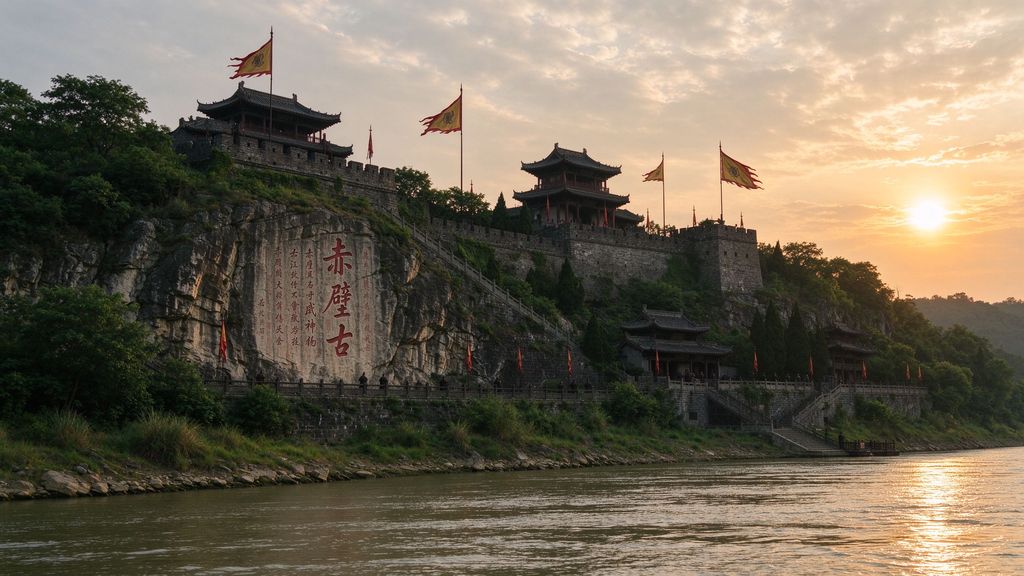
The Romance of the Three Kingdoms, one of the four great classical novels, was written by Luo Guanzhong from Three Kingdoms history, telling the story of Wei, Shu and Wu vying for supremacy.
Cast: Liu Bei (benevolence), Guan Yu (loyalty), Zhang Fei (valour), Zhuge Liang (wisdom), Cao Cao (genius and villain in one), Sun Quan (steadiness) - vivid and beloved.
Classic scenes: the Peach Garden Oath, three visits to the thatched cottage, borrowing arrows with straw boats, the empty-city stratagem, borrowing the east wind, passing five passes and slaying six generals; sayings like "why did Yu exist if Liang lived" and "carelessness lost Jingzhou" are everyday Chinese.
History vs novel: the real Zhuge Liang was no demigod (per the Records of the Three Kingdoms), and Cao Cao was no pure villain - the romance is 70% truth, 30% fiction.
Influence: Peking opera, storytelling, games (Sangokushi, Dynasty Warriors), film and anime all draw on it - the Japanese are especially obsessed.
Travel: Chengdu Wuhou Shrine (honouring Zhuge Liang), the Chibi battlefield in Hubei, Cao Cao residence in Xuchang; "Three Kingdoms City" film sets across the country.
Romance of the Three Kingdoms is one of China most famous classical novels, written by Luo Guanzhong in the late Yuan and early Ming. It tells the story of the Three Kingdoms period (220-280) and the struggle among Wei, Shu and Wu.
The novel begins with the fall of the Eastern Han: the Yellow Turban uprising, Dong Zhuo tyranny, warlords rising. Liu Bei, Guan Yu and Zhang Fei swear brotherhood in the Peach Garden, vowing to restore the Han.
Cao Cao is the most complex figure: "rather I wrong the world than the world wrong me." Brilliant yet suspicious, he is called the "cunning hero of troubled times".
Zhuge Liang is the embodiment of wisdom: settling the tripartite plan before leaving his thatched hut; borrowing the east wind, borrowing arrows with straw boats, the empty-city stratagem - plans passed down forever. His "exhausting himself to death" spirit moves countless people.
Guan Yu embodies loyalty: crossing five passes and slaying six generals, riding a thousand li alone. Posthumously honoured as "sage of martial arts", he ranks with Confucius as the "two sages of culture and war".
The Battle of Red Cliffs is the climax: Zhou Yu and Zhuge Liang together, using fire to rout Cao Cao hundred-thousand army. The novel fire scene is breathtaking.
The book is not just history but a book of strategy: many of the Thirty-Six Stratagems come from its stories. Business circles in Japan and Korea even read it as a management text.
It contributed countless idioms: three visits to the thatched cottage, borrowing arrows with straw boats, too happy to think of Shu, losing Jingzhou through carelessness. Chinese use them daily.
Historical reality differs from the novel: Zhuge Liang was less divine, Zhou Yu less petty, Liu Bei less weak. But the novel made the Three Kingdoms a national memory.
"Three heroes versus Lü Bu", "boiling wine discussing heroes", "a thousand-li lone ride" - Chinese grow up hearing these tales and retell them with relish.
In 1994 China filmed the TV series, a shared memory of generations; Japan also made Three Kingdoms games popular worldwide.
For Chinese learners, reading some Three Kingdoms helps: its half-classical language is great material for classical Chinese, and the stories are endlessly interesting.
The empire, long divided, must unite; long united, must divide - the charm of the tale lies in heroes, strategy and fate colliding.

